(714) 213-8451
Fire sprinkler systems cost between $1.50 and $3.50 per square foot for new construction and $4 to $10 per square foot for retrofits. A 2,500 square foot home runs $3,750 to $8,750 for new construction or $10,000 to $25,000 to retrofit. Commercial buildings cost more based on size, system complexity, and occupancy requirements.
Final pricing depends on building size, system type, water supply, and whether you’re installing during construction or adding sprinklers to an existing structure. These costs include equipment, installation labor, permits, and basic system testing.
Average Fire Sprinkler System Costs in Orange County
Residential Fire Sprinkler Costs
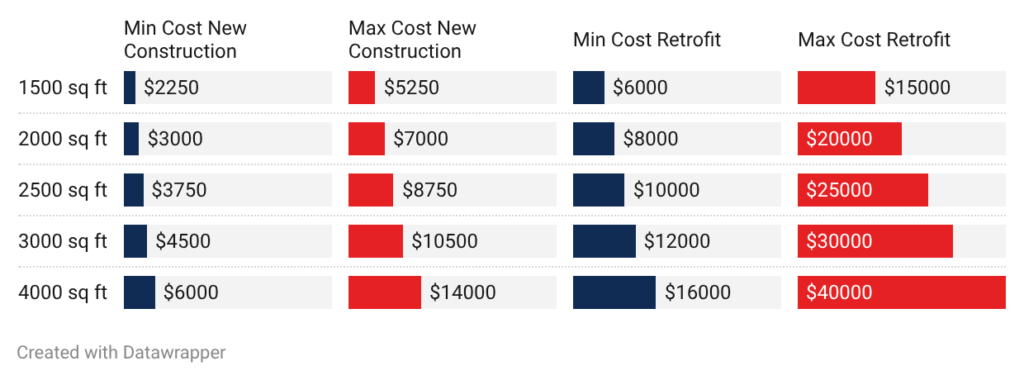
- 1,500 sq ft homes (new construction): Installing sprinklers during construction costs $2,250 to $5,250. Simple single-story layouts with 8-foot ceilings fall at the low end around $2,250 to $3,000. Two-story homes or complex floor plans push costs to $4,500 to $5,250 because they need more piping and additional sprinkler heads.
- 1,500 sq ft homes (retrofit): Adding sprinklers to existing homes costs $6,000 to $15,000. Labor dominates retrofit pricing because contractors cut into finished walls and ceilings, run new pipes, then patch and repaint everything. Homes with attic access cost less than slab-foundation homes where every pipe run requires opening walls.
- 2,000 sq ft homes (new construction): Standard-sized homes run $3,000 to $7,000 during construction. Most systems need 16 to 24 sprinkler heads. Homes with basements or attached garages needing coverage add $1,000 to $2,000 to the base cost.
- 2,000 sq ft homes (retrofit): Retrofitting 2,000 square foot homes costs $8,000 to $20,000. Multi-story homes cost more than single-story because pipes must run between floors. Occupied homes where contractors work around furniture and family schedules run $2,000 to $4,000 higher than vacant homes.
- 2,500 sq ft homes (new construction): Larger new homes cost $3,750 to $8,750. Systems include 20 to 30 sprinkler heads. The per-square-foot cost drops slightly compared to smaller homes because fixed costs like control valves and backflow preventers spread across more square footage.
- 2,500 sq ft homes (retrofit): Retrofitting costs $10,000 to $25,000. Homes with high ceilings in some rooms need special sprinkler placement adding $1,500 to $3,000. Finished basements requiring coverage add another $2,000 to $5,000.
- 3,000 sq ft homes (new construction): Three-thousand square foot homes need $4,500 to $10,500. Custom homes with unique architectural features cost more than standard tract homes. Vaulted ceilings and cathedral spaces complicate sprinkler placement and add to engineering costs.
- 3,000 sq ft homes (retrofit): Retrofit installations run $12,000 to $30,000. Complex layouts with many small rooms need more sprinkler heads than open floor plans. Each additional room adds $300 to $600 to the total cost.
- 4,000 sq ft homes (new construction): Large homes cost $6,000 to $14,000 during construction. Homes needing fire pumps because of weak municipal water pressure add $8,000 to $15,000. Properties on wells almost always need pumps plus storage tanks adding $15,000 to $25,000 total.
- 4,000 sq ft homes (retrofit): Retrofitting large homes costs $16,000 to $40,000. Luxury homes with custom finishes and delicate surfaces cost more because contractors take extra care during installation and finishing work. High-end homes often run $30,000 to $40,000 for complete retrofit installations.
Commercial Fire Sprinkler Costs
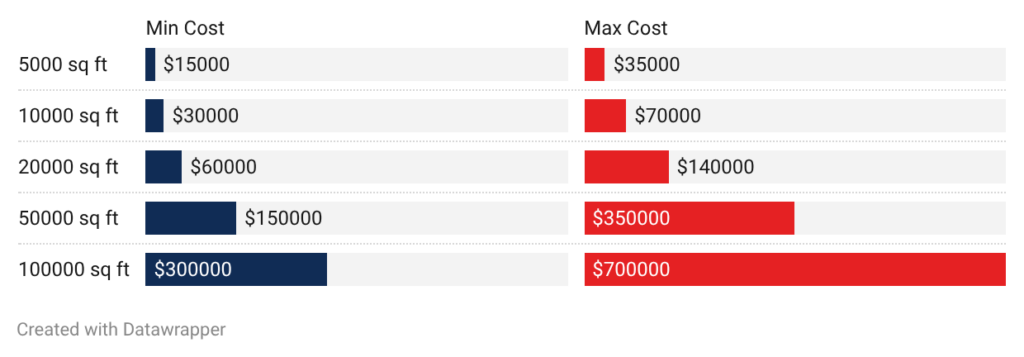
- 5,000 sq ft commercial: Small commercial spaces cost $15,000 to $35,000. Simple office layouts with 10-foot ceilings and standard construction run $15,000 to $22,000. Restaurants needing special kitchen suppression systems or retail stores with 20-foot ceilings cost $28,000 to $35,000.
- 10,000 sq ft commercial: Medium buildings run $30,000 to $70,000. Warehouses storing low-hazard materials like furniture or clothing cost less than warehouses storing aerosols or plastics. Hazard classification directly affects sprinkler density and system cost.
- 20,000 sq ft commercial: Larger installations cost $60,000 to $140,000. Multi-story office buildings need vertical risers and separate zones on each floor adding $15,000 to $25,000 compared to single-story buildings. Fire pumps add another $15,000 to $25,000 when municipal pressure is inadequate.
- 50,000 sq ft commercial: Large buildings need $150,000 to $350,000. Complex occupancies like hospitals or schools have stricter requirements than warehouses. Clean agent suppression in server rooms or special spaces adds $20,000 to $50,000 on top of standard sprinkler costs.
- 100,000 sq ft commercial: Very large projects run $300,000 to $700,000. High-rise buildings over 75 feet tall need standpipes, additional fire pumps, and sometimes rooftop water storage adding $100,000 to $200,000. Manufacturing facilities with special hazards push costs toward the high end.
Fire Sprinkler System Cost Breakdown
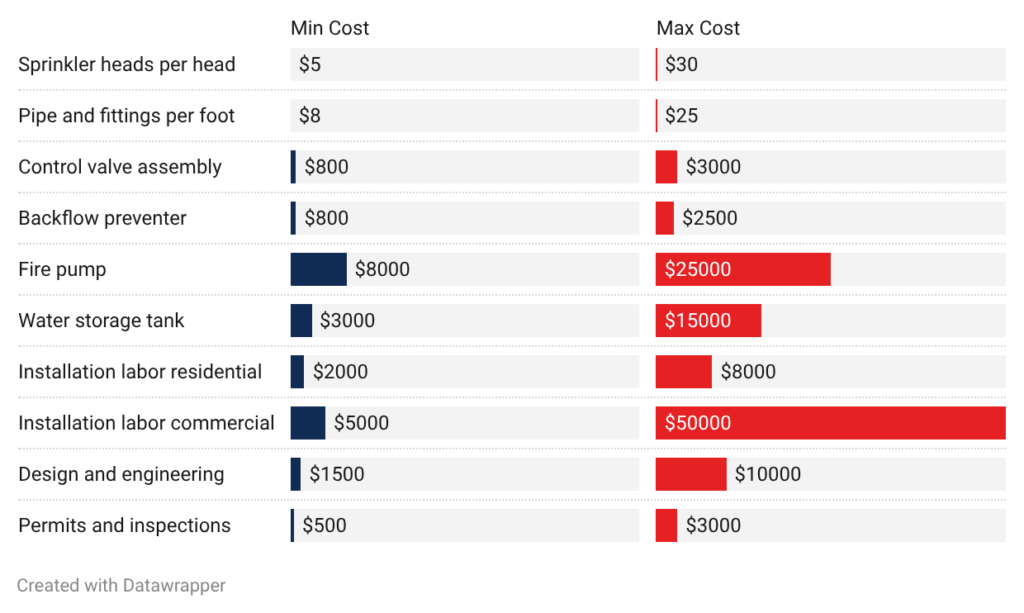
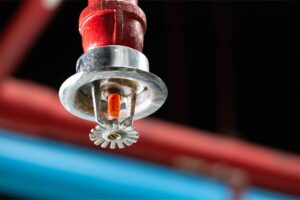
- Sprinkler heads: Individual heads cost $5 to $30 each. Basic pendent or sidewall sprinklers run $5 to $10. Concealed sprinklers with decorative cover plates cost $15 to $30. Quick-response residential sprinklers fall in the middle at $8 to $15 per head.
- Pipe and fittings: Installed pipe costs $8 to $25 per foot. CPVC plastic pipe used in residential systems runs $8 to $12 per foot. Steel pipe required in commercial buildings costs $15 to $25 per foot. This includes hangers, supports, and fittings.
- Control valve assembly: Main control valves cost $800 to $3,000 installed. Simple residential ball valves with test connections run $800 to $1,200. Commercial OS&Y valves with tamper switches and alarm connections cost $2,000 to $3,000.
- Backflow preventer: Required devices cost $800 to $2,500. Small residential units run $800 to $1,200. Large commercial double-check assemblies or reduced-pressure backflow preventers cost $1,500 to $2,500. Annual testing adds $100 to $200 per year.
- Fire pump: Pumps cost $8,000 to $25,000 when municipal water pressure is inadequate. Small residential pumps delivering 50 to 100 GPM run $8,000 to $12,000. Commercial pumps for large buildings cost $15,000 to $25,000 plus $3,000 to $8,000 for electrical installation.
- Water storage tank: Tanks cost $3,000 to $15,000 when properties lack reliable water supplies. Residential tanks holding 500 to 1,000 gallons run $3,000 to $6,000. Commercial tanks holding several thousand gallons cost $10,000 to $15,000.
- Installation labor (residential): Residential labor costs $2,000 to $8,000. New construction with open walls runs $2,000 to $4,000 for average homes. Retrofit installations requiring cutting into finished surfaces cost $5,000 to $8,000.
- Installation labor (commercial): Commercial labor runs $5,000 to $50,000. Small commercial projects need $5,000 to $15,000. Large multi-story buildings with complex systems need $30,000 to $50,000 in labor.
- Design and engineering: Professional design costs $1,500 to $10,000. Simple residential systems need basic plans at $1,500 to $3,000. Complex commercial systems require hydraulic calculations and engineered drawings at $5,000 to $10,000.
- Permits and inspections: Permits cost $500 to $3,000 total. Residential permits run $500 to $1,000 in most jurisdictions. Commercial permits for larger projects cost $1,500 to $3,000. This includes plan review fees and final inspection costs.
What Affects Fire Sprinkler System Cost
Building Size and Layout
Square footage drives total cost because larger buildings need more sprinkler heads and pipe. A 3,000 square foot building needs roughly twice the materials of a 1,500 square foot building. But layout matters as much as size.
Open floor plans allow maximum coverage from each sprinkler head. Buildings divided into many small rooms need more heads because walls limit coverage area. A 2,000 square foot home with 10 large rooms needs fewer sprinklers than a 2,000 square foot medical office divided into 20 exam rooms.
Long narrow buildings need more pipe than square buildings. A 3,000 square foot building that’s 30 feet by 100 feet requires longer pipe runs than a 50 foot by 60 foot building. Pipe length directly affects installation cost.
Ceiling Height
Standard 8 to 10 foot ceilings allow normal sprinkler spacing. Each residential sprinkler typically covers up to 144 square feet with standard ceilings. Higher ceilings reduce coverage area per head.
Ceilings over 12 feet require different sprinkler types or additional heads. Some jurisdictions require intermediate-level sprinklers in spaces with very high ceilings. Each additional sprinkler level adds $2,000 to $5,000 to project costs.
Commercial buildings with 25 to 30 foot ceilings need specialized sprinklers. High-piled storage sprinklers or in-rack sprinklers cost more than standard ceiling sprinklers. Warehouses with high ceilings can run 50% to 100% more than warehouses with 15-foot ceilings.
Water Supply
Adequate municipal water pressure keeps costs down. Systems connect directly to existing water service without pumps or tanks. Most cities provide 50 to 80 PSI which handles most residential and small commercial systems.
Inadequate pressure requires fire pumps adding $8,000 to $25,000. Rural areas, hilltop properties, and areas with weak water systems almost always need pumps. Properties on wells need both pumps and pressure tanks.
Properties without municipal water need storage tanks plus pumps. Tank and pump combinations add $15,000 to $35,000 to total costs. Tank size depends on system demand and how long the system must operate without refilling.
System Type
Wet pipe systems cost least because they’re simplest. Pipes stay filled with water ready to flow when a sprinkler opens. These systems work in most applications and represent the baseline cost.
Dry pipe systems cost 20% to 40% more. Compressed air fills pipes instead of water. Air compressors, special valves, and additional maintenance drive costs up. Only areas at risk of freezing need dry pipe systems.
Pre-action systems cost 50% to 100% more. These systems need fire detection plus sprinkler activation before water flows. The additional detection equipment and complex controls make pre-action systems expensive.
Deluge systems are most expensive at 100% to 200% more than wet pipe. All sprinkler heads stay open and a deluge valve controls water flow. Only high-hazard areas like aircraft hangars or chemical storage need deluge systems.
New Construction vs Retrofit
New construction costs $1.50 to $3.50 per square foot. Contractors install systems when walls are open before drywall. Piping runs easily through framing with no demolition or patching needed.
Retrofits cost $4 to $10 per square foot. Contractors cut into finished walls and ceilings, run pipes, then patch and finish everything. The demolition and restoration work doubles or triples labor costs compared to new construction.
Occupied buildings cost more to retrofit than vacant buildings. Contractors protect furnishings, work around occupants, and clean up daily. These constraints slow work and increase labor hours by 20% to 30%.
Pipe Material
CPVC plastic pipe costs $8 to $12 per foot installed. Most residential systems use CPVC because it’s approved by code and costs less than steel. The lightweight material installs faster than steel reducing labor costs.
Steel pipe costs $15 to $25 per foot installed. Commercial buildings typically require steel pipe. Black steel, galvanized steel, and stainless steel all have different costs with stainless running highest.
Some jurisdictions require steel pipe even in residential applications. California allows CPVC in homes but some local fire marshals prefer steel. Check local requirements before assuming CPVC is acceptable.
Sprinkler Head Types
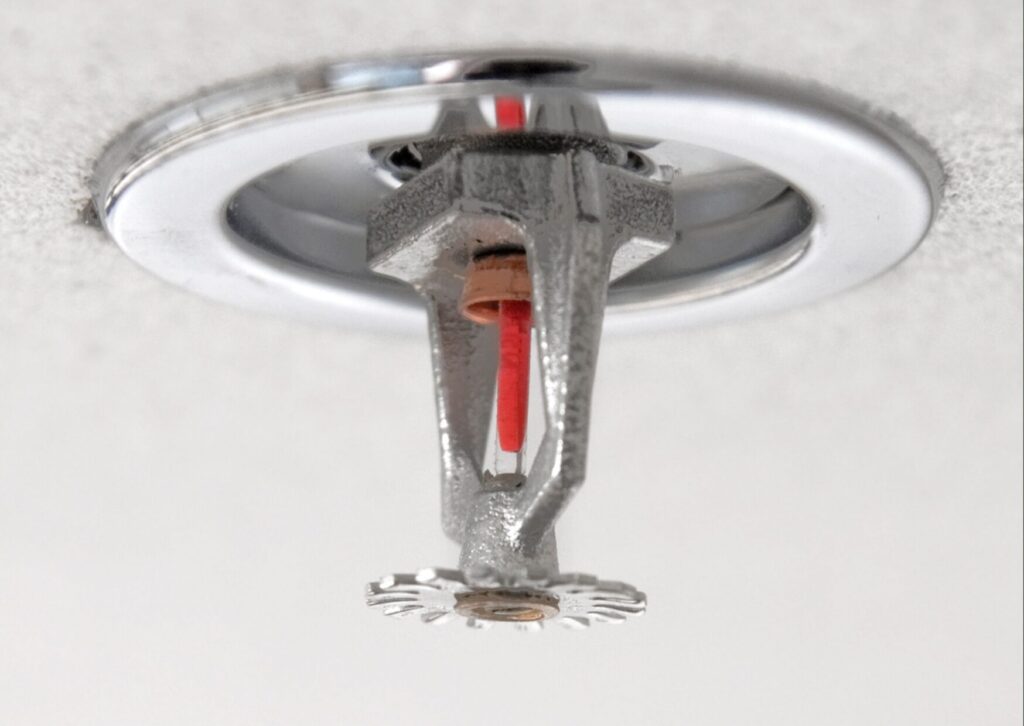
Standard pendent and sidewall heads cost $5 to $10 each. These basic heads provide reliable protection at minimum cost. They’re visible on ceilings or walls and come in chrome or white finishes.
Concealed heads cost $15 to $30 each. Cover plates hide the sprinkler when not in use. Heat releases the cover plate exposing the sprinkler during fires. Homeowners pay extra for concealed heads to improve appearance.
Extended coverage heads cost $20 to $40 each but cover larger areas. Using fewer heads over more square footage sometimes saves money despite higher per-head costs. These work best in open areas without obstructions.
Fire Pump Requirements
Fire pumps add $8,000 to $25,000 when needed. Small residential pumps delivering 50 to 100 GPM cost $8,000 to $12,000. Commercial pumps for large buildings run $15,000 to $25,000.
Electrical service to pumps adds $2,000 to $5,000. Pumps need dedicated circuits with proper disconnect switches. Running new service from the main panel to the pump location increases electrical costs.
Ongoing pump costs include weekly testing and annual professional service. Budget $300 to $600 per year for pump maintenance beyond basic sprinkler system maintenance.
Residential Fire Sprinkler System Costs by Home Size in Orange County
Small Homes (Under 2,000 sq ft)
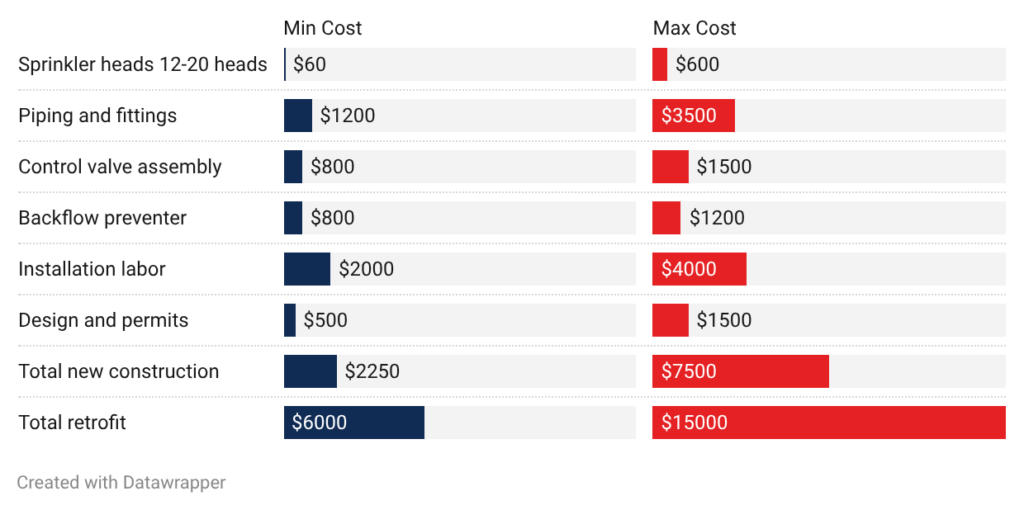
- Sprinkler heads: Small homes need 12 to 20 heads at $60 to $600 total. Using basic $5 heads keeps costs at $60 to $100. Concealed $25 heads push costs to $300 to $600.
- Piping and fittings: Pipe costs $1,200 to $3,500. Simple single-story layouts run $1,200 to $2,000. Two-story homes need $2,500 to $3,500 for additional vertical runs and second-floor distribution.
- Control valve assembly: Main control valves cost $800 to $1,500. This includes the valve, test connection, drain, and trim. Residential valves cost less than commercial OS&Y valves.
- Backflow preventer: Required devices run $800 to $1,200. Most small homes use 1-inch or 1.5-inch backflow preventers at the lower end of this range.
- Installation labor: Labor costs $2,000 to $4,000. New construction labor runs $2,000 to $2,500. Retrofit labor climbs to $3,500 to $4,000 because of demolition and finishing work.
- Design and permits: Design and permitting run $500 to $1,500. Simple plans and standard permits cost $500 to $800. Complex layouts or strict jurisdictions need $1,200 to $1,500.
Medium Homes (2,000-3,500 sq ft)
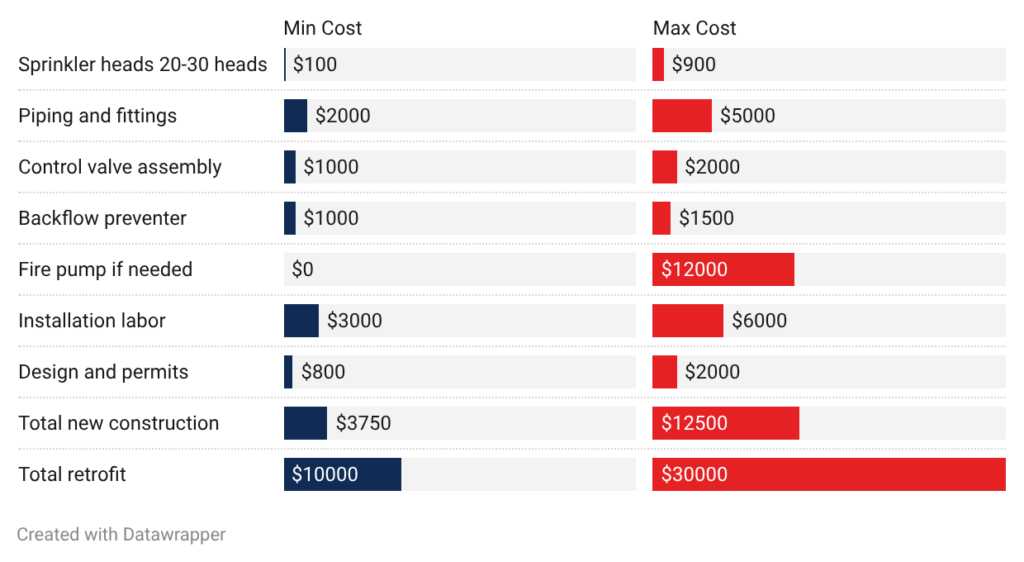
- Sprinkler heads: Medium homes need 20 to 30 heads at $100 to $900. Most homeowners mix basic heads in garages and basements with concealed heads in living areas balancing cost and appearance.
- Piping and fittings: Pipe runs $2,000 to $5,000. Multi-story homes need more pipe than single-story. Basements and attached garages requiring coverage add $800 to $1,500.
- Control valve assembly: Control valves cost $1,000 to $2,000. More complex systems with multiple zones need higher-end assemblies.
- Backflow preventer: Backflow devices run $1,000 to $1,500. Larger homes sometimes need 2-inch backflow preventers costing more than 1-inch units.
- Fire pump: Pumps add $0 to $12,000 when needed. Homes with adequate municipal pressure don’t need pumps. Properties on wells or with weak water service need pumps at the high end.
- Installation labor: Labor costs $3,000 to $6,000. New construction runs $3,000 to $4,000. Retrofits need $5,000 to $6,000 because of finishing work.
- Design and permits: Design and permits cost $800 to $2,000. Medium homes need more detailed plans than small homes. Some jurisdictions require engineered drawings adding to design costs.
Large Homes (Over 3,500 sq ft)
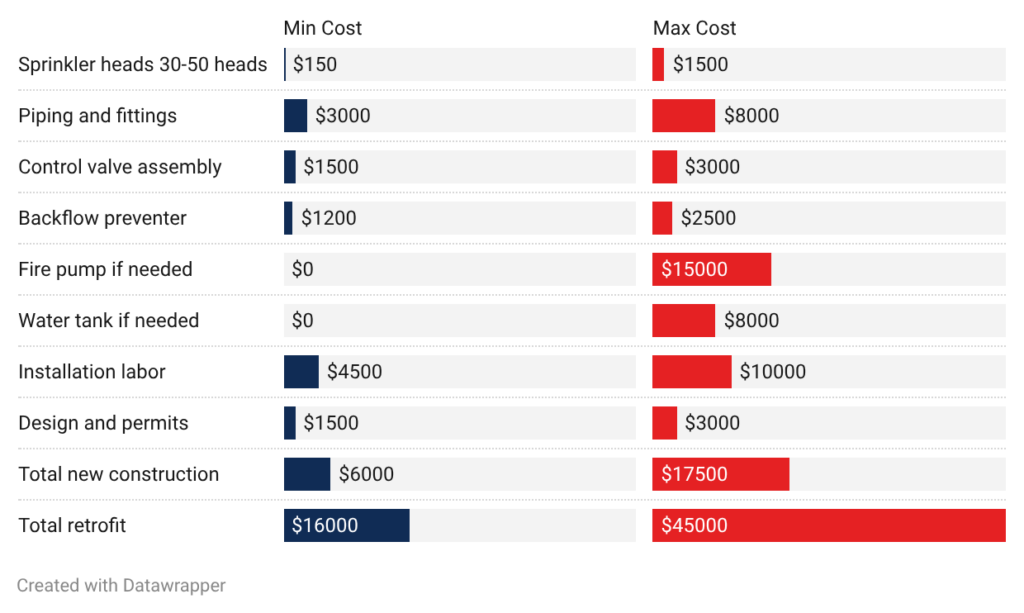
- Sprinkler heads: Large homes need 30 to 50 heads at $150 to $1,500. Using all concealed heads costs $750 to $1,500. Mixing head types reduces costs to $300 to $600.
- Piping and fittings: Extensive piping costs $3,000 to $8,000. Complex floor plans with multiple wings need more pipe than simple rectangular layouts. High ceilings require additional vertical pipe.
- Control valve assembly: Large home valves run $1,500 to $3,000. Multi-zone systems or systems with special features need complex valve assemblies.
- Backflow preventer: Large systems need $1,200 to $2,500 backflow devices. Higher flow requirements demand larger and more expensive units.
- Fire pump: Many large homes need pumps at $0 to $15,000. Pump size depends on system demand and available water pressure. Large homes on wells almost always need pumps.
- Water tank: Rural properties need tanks at $0 to $8,000. Tank size depends on system demand. Large homes might need 1,000 to 2,000 gallon tanks.
- Installation labor: Labor runs $4,500 to $10,000. Even new construction takes significant time in large homes. Retrofit labor climbs higher because of extensive demolition and finishing.
- Design and permits: Engineering and permits cost $1,500 to $3,000. Large homes need detailed hydraulic calculations. Professional engineer stamps required in some jurisdictions add to design costs.
Commercial Fire Sprinkler System Costs by Building Size
Small Commercial (5,000-10,000 sq ft)
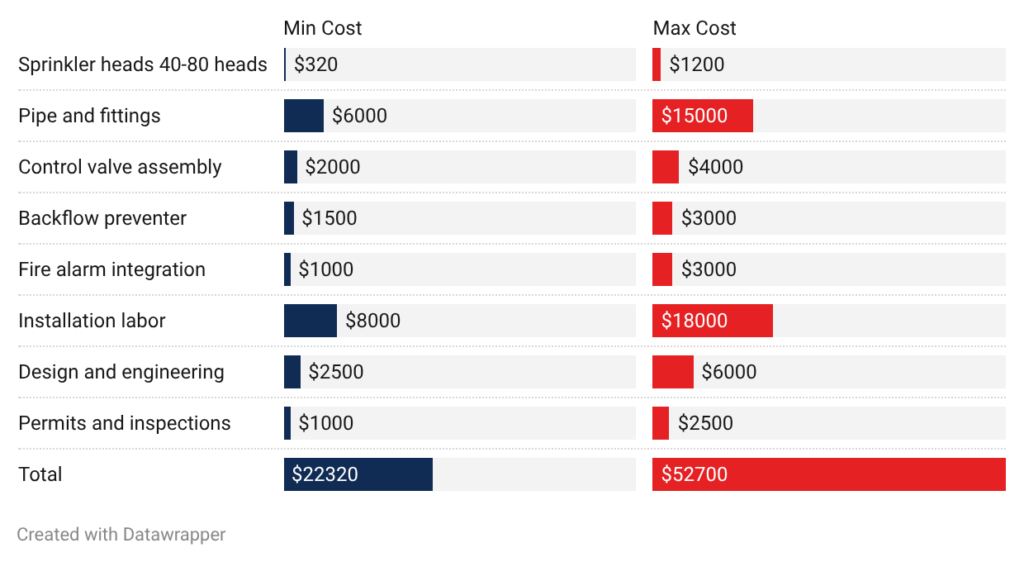
- Sprinkler heads: Small commercial buildings need 40 to 80 heads at $320 to $1,200. Commercial quick-response heads cost $8 to $15 each. Higher-hazard areas need special heads costing more.
- Pipe and fittings: Steel pipe costs $6,000 to $15,000. Simple single-story buildings run $6,000 to $9,000. Multi-story or complex layouts need $12,000 to $15,000.
- Control valve assembly: Commercial valves cost $2,000 to $4,000. OS&Y valves with tamper switches, flow switches, and alarm connections cost more than residential valves.
- Backflow preventer: Commercial backflow devices run $1,500 to $3,000. Double-check assemblies or reduced-pressure devices handle commercial flow requirements.
- Fire alarm integration: Connecting to fire alarms costs $1,000 to $3,000. This includes waterflow switches, tamper switches, and control modules.
- Installation labor: Labor runs $8,000 to $18,000. New construction falls at the low end. Retrofit installations in occupied buildings climb to $15,000 to $18,000.
- Design and engineering: Engineering costs $2,500 to $6,000. Commercial systems need hydraulic calculations and professional drawings. Some jurisdictions require PE stamps.
- Permits and inspections: Permits cost $1,000 to $2,500. Commercial permits cost more than residential. Multiple inspections during construction add to the total.
Medium Commercial (10,000-30,000 sq ft)
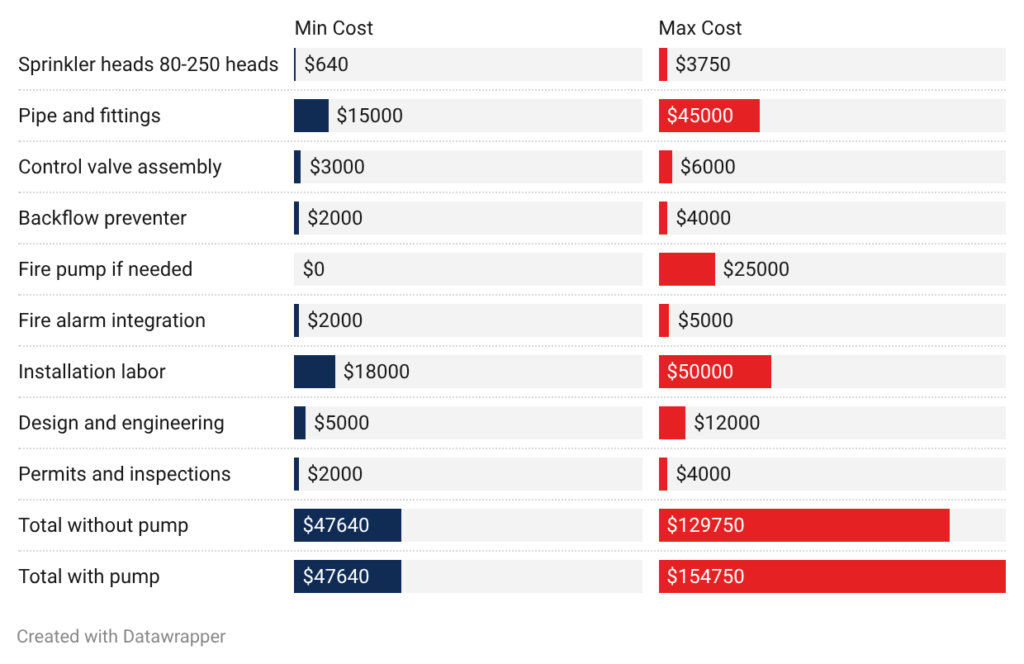
- Sprinkler heads: Medium buildings need 80 to 250 heads at $640 to $3,750. Head count varies by ceiling height and hazard level. Warehouses need more heads than offices.
- Pipe and fittings: Piping costs $15,000 to $45,000. Multi-story buildings need vertical risers adding $5,000 to $10,000. Complex layouts increase pipe requirements.
- Control valve assembly: Control assemblies run $3,000 to $6,000. Multi-zone systems need multiple valve assemblies at $2,000 to $3,000 each.
- Backflow preventer: Backflow devices cost $2,000 to $4,000. Larger buildings need bigger assemblies handling higher flow rates.
- Fire pump: Pumps add $0 to $25,000 when needed. Buildings over two stories often need pumps. Pump size depends on building height and system demand.
- Fire alarm integration: Integration costs $2,000 to $5,000. Multiple zones need multiple monitoring points. Complex alarm systems cost more to integrate.
- Installation labor: Labor runs $18,000 to $50,000. Multi-story buildings and complex systems take more time. Occupied buildings need careful coordination.
- Design and engineering: Engineering costs $5,000 to $12,000. Larger systems need more extensive hydraulic analysis. Multiple zones and special hazards add engineering time.
- Permits and inspections: Permits cost $2,000 to $4,000. Larger projects face higher fees. Multiple inspections during construction contribute to costs.
Large Commercial (Over 30,000 sq ft)
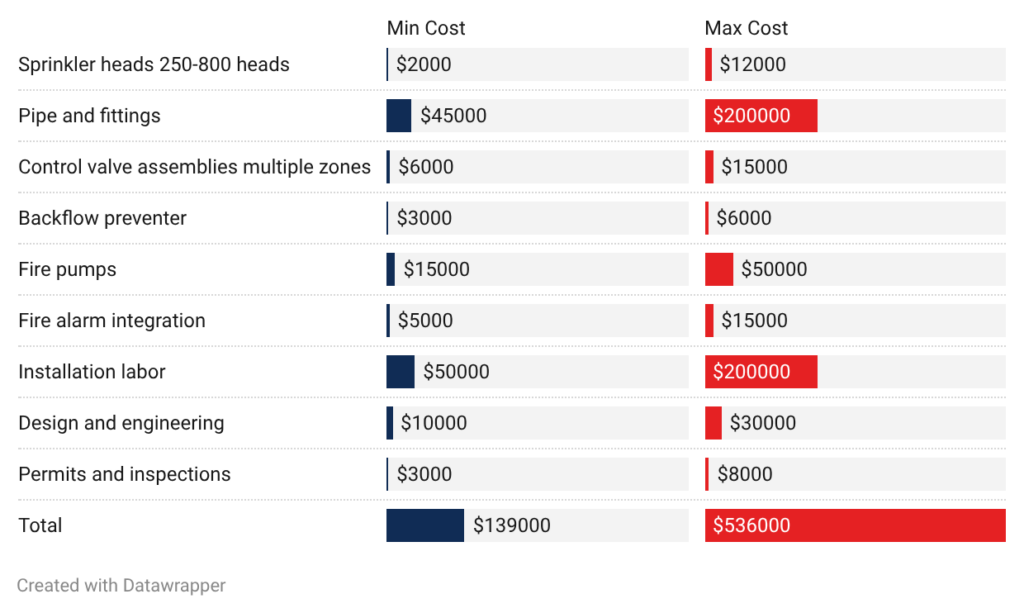
- Sprinkler heads: Large buildings need 250 to 800+ heads at $2,000 to $12,000. Very large warehouses exceed 1,000 heads. Industrial facilities with special hazards need expensive specialty heads.
- Pipe and fittings: Extensive piping costs $45,000 to $200,000. Main supply lines, zone distribution, and branch lines create complex networks. Multi-story buildings need substantial vertical piping.
- Control valve assemblies: Multiple zones need $6,000 to $15,000 in valve assemblies. Each floor or fire area typically has its own control valve at $2,000 to $3,000.
- Backflow preventer: Large systems need $3,000 to $6,000 backflow devices. Some buildings need multiple backflow preventers for different system zones.
- Fire pumps: Large buildings almost always need pumps at $15,000 to $50,000. Multiple pumps for redundancy or increased capacity push costs higher. High-rise buildings need substantial pumping capacity.
- Fire alarm integration: Complex integration costs $5,000 to $15,000. Extensive monitoring, multiple notification zones, and sophisticated controls drive integration costs up.
- Installation labor: Labor dominates at $50,000 to $200,000. Multi-story buildings and complex occupancies need significant installation time. Some projects take months to complete.
- Design and engineering: Comprehensive engineering runs $10,000 to $30,000. Large projects need detailed hydraulic analysis and extensive documentation. Multiple design revisions are common.
- Permits and inspections: Permits cost $3,000 to $8,000. Large commercial projects face the highest fees. Multiple inspections throughout construction add to total costs.
Fire Sprinkler System Cost by System Type
Wet Pipe System Costs
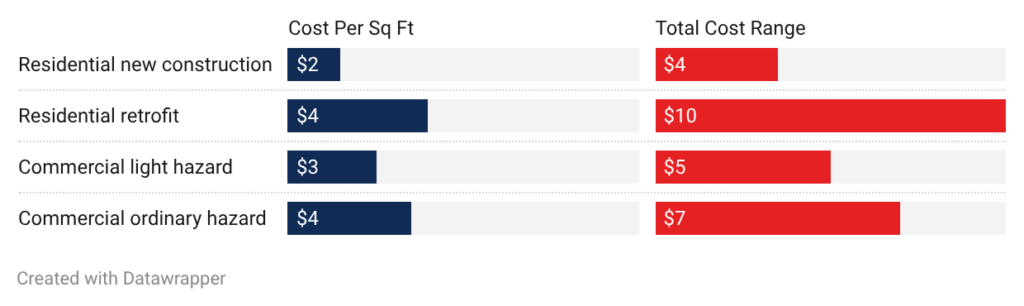
- Residential new construction: Wet pipe systems cost $1.50 to $3.50 per square foot. Simple layouts with standard ceilings run $1.50 to $2.00. Complex floor plans or high ceilings push costs to $3.00 to $3.50.
- Residential retrofit: Retrofitting costs $4.00 to $10.00 per square foot. Easy retrofits with attic access run $4.00 to $6.00. Difficult retrofits in slab homes with no attic access cost $8.00 to $10.00.
- Commercial light hazard: Office buildings cost $2.50 to $5.00 per square foot. Light hazard means limited combustible contents. Simple layouts run $2.50 to $3.50. Complex spaces cost $4.00 to $5.00.
- Commercial ordinary hazard: Retail and warehouse spaces cost $3.50 to $7.00 per square foot. Ordinary hazard requires denser sprinkler spacing than light hazard. High ceilings or special storage push costs to $6.00 to $7.00.
Dry Pipe System Costs
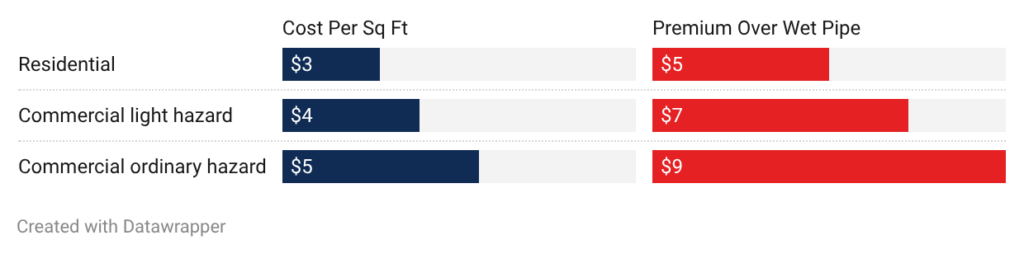
- Residential dry pipe: Dry systems cost $2.50 to $4.50 per square foot. This represents 40% to 60% more than wet pipe. Air compressors add $1,500 to $3,000. Special dry pipe valves cost $2,000 to $4,000.
- Commercial light hazard: Light-hazard dry pipe runs $3.50 to $6.50 per square foot. The premium covers air compressor, dry pipe valve, and additional installation complexity.
- Commercial ordinary hazard: Ordinary hazard dry pipe costs $5.00 to $9.00 per square foot. Higher sprinkler density combined with dry pipe complexity drives costs up.
Pre-Action System Costs
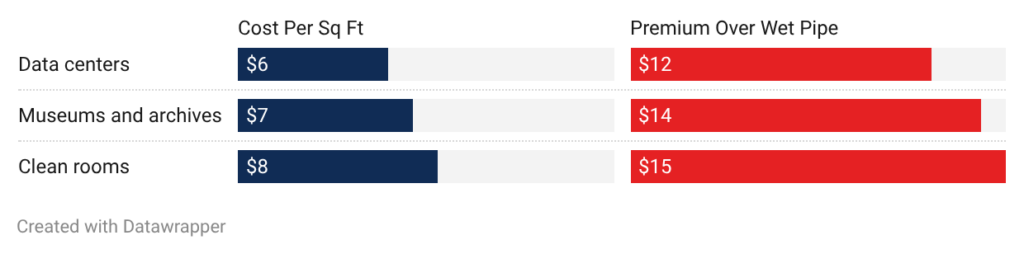
- Data centers: Pre-action systems cost $6.00 to $12.00 per square foot. Sophisticated fire detection adds $2.00 to $4.00 per square foot. Pre-action valves and controls add another $2,000 to $5,000.
- Museums and archives: Protecting irreplaceable collections costs $7.00 to $14.00 per square foot. Extremely sensitive detection needed to prevent false discharges drives costs higher than standard applications.
- Clean rooms: Clean room pre-action runs $8.00 to $15.00 per square foot. Maintaining clean room standards while providing fire protection creates unique challenges requiring specialized engineering.
Deluge System Costs
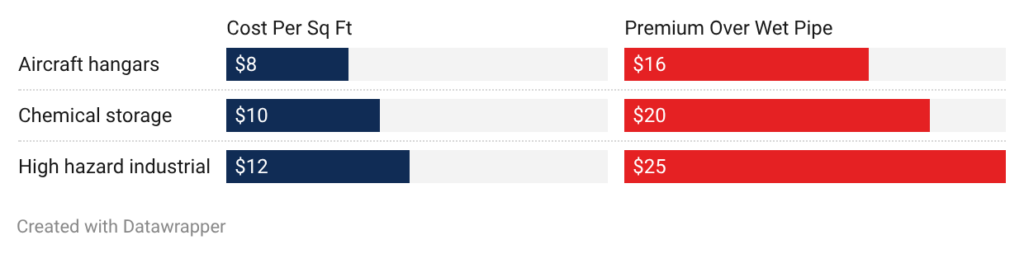
- Aircraft hangars: Deluge systems cost $8.00 to $16.00 per square foot. Foam concentrate systems add $3.00 to $5.00 per square foot. Specialized foam-water discharge devices cost more than standard sprinklers.
- Chemical storage: Chemical storage protection runs $10.00 to $20.00 per square foot. Special chemicals or agents for specific fire types increase costs. Custom engineering for hazardous materials adds to design fees.
- High hazard industrial: The most demanding applications cost $12.00 to $25.00 per square foot. Combining water with foam or special agents drives material costs up. Extensive testing and commissioning add to labor costs.
New Construction vs Retrofit Installation Costs
New Construction Cost Analysis
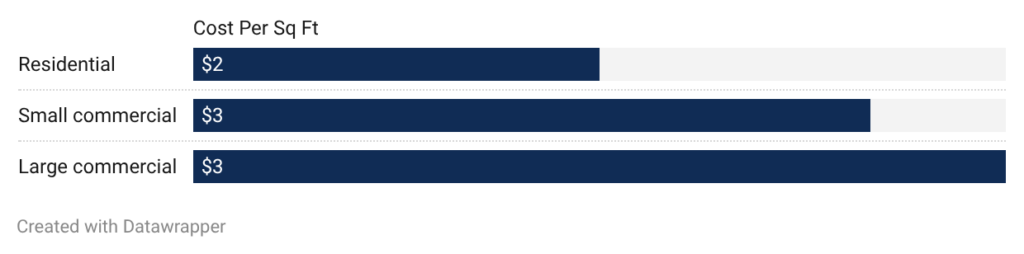
- Residential new construction: New homes cost $1.50 to $3.50 per square foot. Labor represents 40% at $0.60 to $1.40 per square foot. Materials represent 60% at $0.90 to $2.10 per square foot. Open walls allow efficient installation minimizing labor.
- Small commercial new construction: Small commercial buildings run $2.50 to $5.00 per square foot. Labor increases to 45% because of more complex systems and stricter codes. Materials drop to 55% as labor complexity increases.
- Large commercial new construction: Large projects cost $3.00 to $6.00 per square foot. Labor drops to 40% because of economies of scale. Material costs dominate at 60% because of extensive piping networks.
Retrofit Installation Cost Analysis
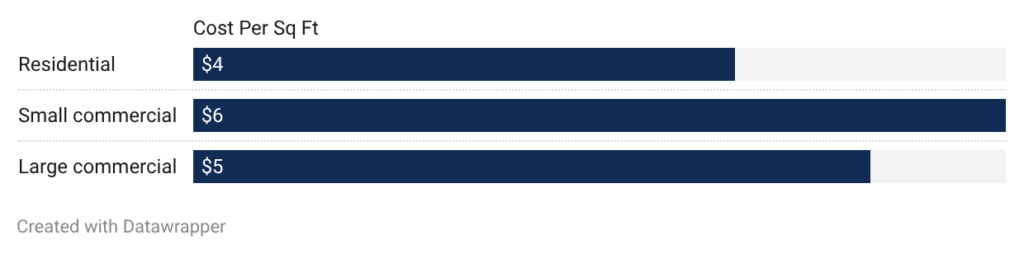
- Residential retrofit: Retrofits cost $4.00 to $10.00 per square foot. Labor dominates at 60% or $2.40 to $6.00 per square foot. Materials drop to 40% at $1.60 to $4.00 per square foot. Demolition and finishing work drive labor costs up.
- Small commercial retrofit: Small commercial retrofits run $6.00 to $12.00 per square foot. Labor jumps to 65% at $3.90 to $7.80 per square foot. Working in occupied buildings increases labor complexity and time.
- Large commercial retrofit: Large retrofits cost $5.00 to $9.00 per square foot. Labor represents 60% at $3.00 to $5.40 per square foot. Some economies of scale reduce the per-square-foot cost compared to small retrofits.
Additional Costs to Budget For
Monitoring and Alarm Costs
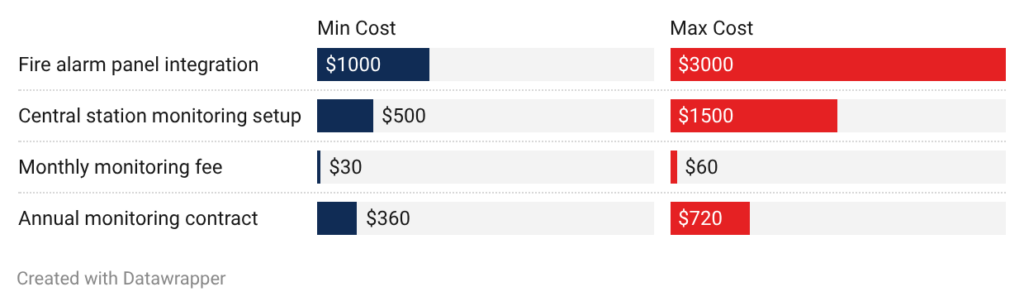
- Fire alarm panel integration: Connecting sprinklers to fire alarms costs $1,000 to $3,000. This includes waterflow switches at $300 to $500 each, tamper switches at $250 to $400 each, and control modules at $400 to $800.
- Central station monitoring setup: Initial setup runs $500 to $1,500. Cellular communicators cost $400 to $800. Programming and testing add $200 to $400. Connection fees vary by monitoring company.
- Monthly monitoring fee: Ongoing monitoring costs $30 to $60 per month. Residential systems run $30 to $40. Commercial systems cost $40 to $60. Complex systems with many zones cost more.
- Annual monitoring contract: Total annual costs run $360 to $720. Multi-year contracts sometimes offer 10% to 15% discounts. Some companies charge activation fees for each alarm event.
Maintenance and Testing Costs
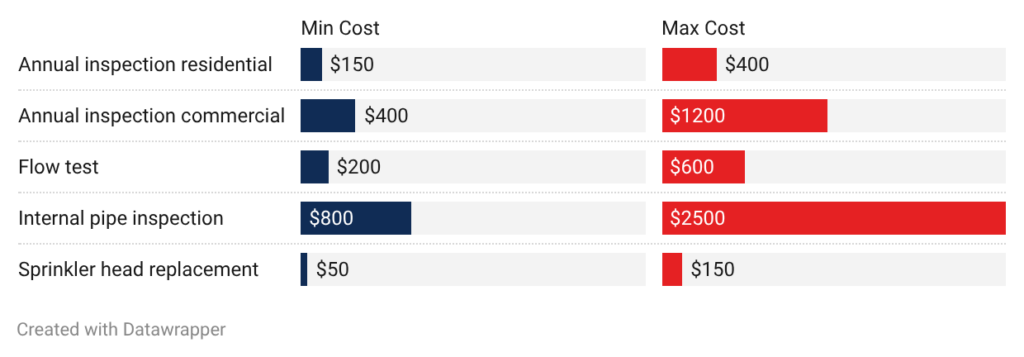
- Annual inspection (residential): Residential inspections cost $150 to $400 per year. Simple systems run $150 to $250. Complex systems with pumps or multiple zones cost $300 to $400. Inspections take one to two hours.
- Annual inspection (commercial): Commercial inspections run $400 to $1,200 per year. Small buildings cost $400 to $600. Large buildings with multiple zones need $800 to $1,200. Some occupancies need quarterly inspections instead.
- Flow test: Five-year flow tests cost $200 to $600. Testing verifies water supply adequacy. Contractors measure flow rate and pressure at test connections. Results must meet original design specifications.
- Internal pipe inspection: Five-year internal inspections cost $800 to $2,500. Contractors drain the system and open pipes to check for corrosion. Problems found can cost $2,000 to $10,000 to fix.
- Sprinkler head replacement: Replacing damaged heads costs $50 to $150 each. This includes the new head at $10 to $30, labor at $30 to $80, and system testing at $10 to $40.
Repair and Replacement Costs
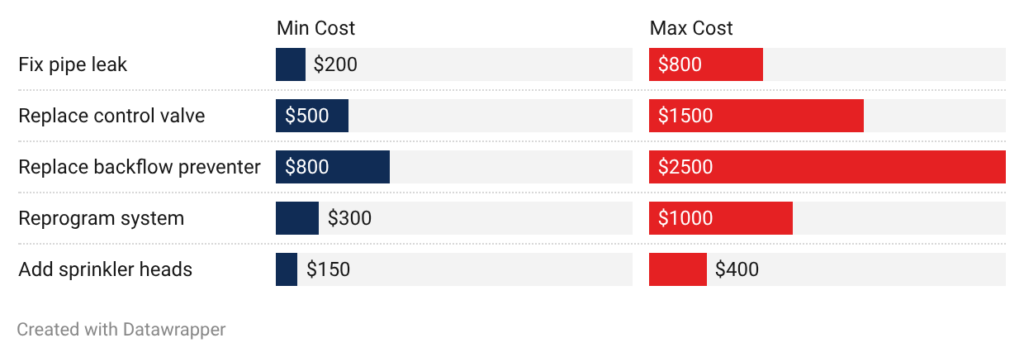
- Fix pipe leak: Leak repairs cost $200 to $800. Accessible leaks run $200 to $400. Leaks in concealed spaces requiring cutting walls cost $500 to $800. Frozen pipe damage can exceed these costs.
- Replace control valve: Valve replacement costs $500 to $1,500. Residential valves run $500 to $800. Commercial OS&Y valves with monitoring cost $1,000 to $1,500. This includes installation labor and system testing.
- Replace backflow preventer: Backflow replacement costs $800 to $2,500. Small residential units run $800 to $1,200. Large commercial assemblies cost $1,500 to $2,500. Devices typically last 15 to 20 years.
- Reprogram system: System reprogramming costs $300 to $1,000. Simple zone changes run $300 to $500. Complex modifications to coverage or detection logic cost $700 to $1,000.
- Add sprinkler heads: Adding heads costs $150 to $400 per head. This includes tapping into existing pipes at $50 to $100, running new branch lines at $50 to $150, and installing the head at $50 to $150.
Ongoing Maintenance and Testing Costs
California follows NFPA 25 requirements for fire sprinkler inspection, testing, and maintenance. Annual inspections are mandatory for all systems.
Annual inspections include visual inspection of all sprinkler heads, control valve checks, water flow alarm testing, pressure gauge verification, pump testing when present, and backflow preventer operation checks. Technicians document all findings in written reports.
Residential annual inspections cost $150 to $400. Inspectors visit the property, test components, and provide documentation. Simple systems take one hour. Complex systems with pumps need two hours.
Commercial annual inspections cost $400 to $1,200. Large buildings with multiple zones need several hours. Complex systems with pumps, tanks, and special features cost more because testing takes longer.
Some commercial occupancies need quarterly inspections instead of just annual. High-hazard facilities and certain healthcare buildings face stricter requirements adding $800 to $2,400 to annual maintenance costs.
NFPA 25 requires additional testing every five years. Flow testing verifies water supply adequacy at $200 to $600. Internal pipe inspection checks for corrosion and obstructions at $800 to $2,500.
California requires annual backflow preventer testing separate from sprinkler inspections. Testing costs $100 to $200 per device. Failed tests require repair at $200 to $500 or replacement at $800 to $2,500.
Southern California Regional Cost Comparison
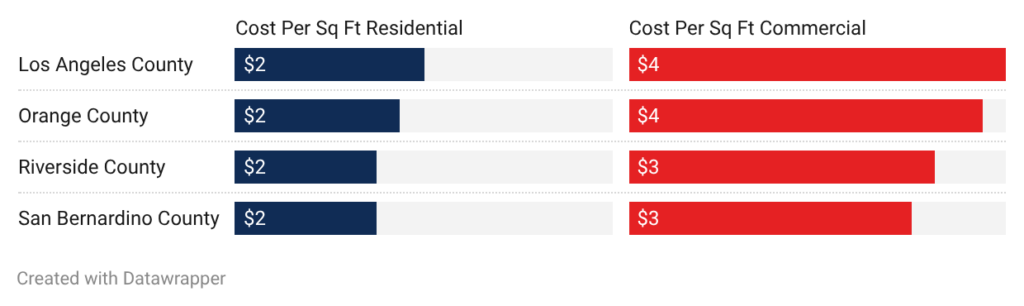
- Los Angeles County: Los Angeles County residential systems cost $2.00 to $4.00 per square foot for new construction. Commercial systems run $4.00 to $8.00 per square foot. A 2,500 square foot home needs $5,000 to $10,000. Labor rates run $75 to $110 per hour. Permit fees are 20% to 30% higher than surrounding counties.
- Orange County: Orange County residential costs $1.75 to $3.75 per square foot. Commercial runs $3.50 to $7.50 per square foot. A typical home needs $4,375 to $9,375. Labor rates run $70 to $100 per hour. Permit fees fall between LA County and inland counties.
- Riverside County: Riverside County residential systems cost $1.50 to $3.25 per square foot. Commercial runs $3.00 to $6.50 per square foot. A 2,500 square foot home needs $3,750 to $8,125. Labor rates drop to $65 to $90 per hour. Permit fees are lower than coastal counties.
- San Bernardino County: San Bernardino County has the lowest costs at $1.50 to $3.00 per square foot residential and $2.75 to $6.00 commercial. A typical home needs $3,750 to $7,500. Labor runs $60 to $85 per hour. Permit fees are lowest in Southern California.
Final Thoughts
Fire sprinkler system costs range from $2,250 to $17,500 for residential installations and $15,000 to $700,000 for commercial buildings. New construction costs $1.50 to $3.50 per square foot. Retrofits cost $4 to $10 per square foot because of additional labor working around existing construction.
System type significantly affects pricing. Wet pipe systems cost less than dry pipe, pre-action, or deluge systems. Water supply determines whether you need expensive pumps or tanks. Building size, layout, and occupancy all influence final costs. A complete fire protection plan also includes properly maintained fire hydrant services to ensure adequate water supply when your sprinkler system needs it most.
Spectrum Fire Protection designs and installs fire sprinkler systems throughout Los Angeles County, Orange County, Riverside County, and San Bernardino County. We hold California C-16 fire protection contractor licenses and have installed systems in thousands of residential and commercial buildings. Call us at (714) 213-8451 to discuss your fire sprinkler project and receive a detailed written quote.