

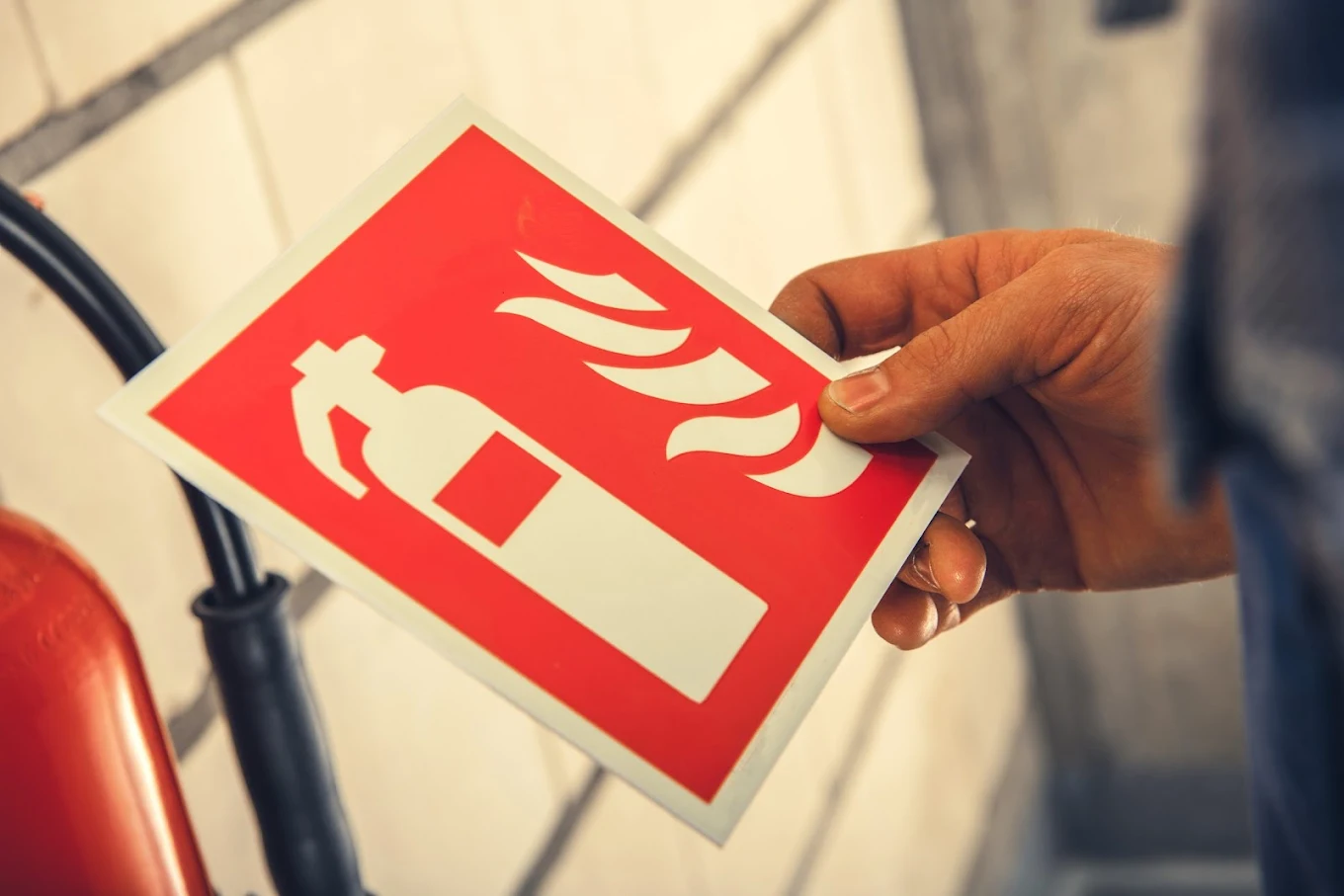
If you own or manage a commercial building in Orange County, you're required by California law to have fire extinguishers and where they go, what class they need to be, and how many you need is not a guess. It's defined by NFPA 10, layered with California Fire Code, Cal/OSHA Title 8, and local enforcement by OCFA or your city fire department. Get any part wrong, and the fire marshal cites you on the next inspection.
After 39 years providing fire protection in Orange County, we've inventoried thousands of OC commercial buildings, restaurants, hotels, warehouses, schools, hospitals, data centers, and multi-family complexes. This guide explains exactly what your building needs, in the order the inspector will check it.
The quick answer
Every commercial building in California needs Class A fire extinguishers placed so no point on the floor is more than 75 feet from one (NFPA 10). Buildings with flammable liquids need Class B extinguishers within 30-50 feet. Commercial kitchens need Class K extinguishers within 30 feet of cooking equipment. Server rooms, electrical closets, and data centers need Class C-rated or clean-agent extinguishers. Extinguishers must be mounted between 3.5 and 5 feet from the floor, inspected annually, and serviced every 6 years.
The five fire classes and which extinguishers cover them
Before you can figure out how many extinguishers your building needs, you have to know what kinds of fires can happen there. NFPA 10 classifies fires into five categories each requires a different extinguishing agent because using the wrong one can make the fire worse or kill someone.
Most commercial buildings need a combination typically ABC dry chemical units throughout for general coverage, supplemented by Class K in kitchen areas, Class C or clean agent in server rooms, and Class B near any flammable liquid storage. We help OC property owners build the right inventory through our extinguisher service program.
How many extinguishers you need: the travel distance rule
This is the rule that determines extinguisher count for your building. NFPA 10 Section 6.2 specifies the maximum distance any occupant can travel to reach an extinguisher and "travel distance" means walking distance through actual paths, not straight-line distance through walls.
Class A hazards 75-foot maximum
For Class A hazards (any space with ordinary combustibles, which is essentially every commercial space), no point on the floor can be more than 75 feet from an appropriate Class A extinguisher. In practice, this works out to extinguishers placed roughly every 150 feet along normal paths of travel 75 feet from any direction. Each Class A extinguisher must be rated at least 2-A (most ABC units are 3-A or 4-A and cover this easily).
Class B hazards 30 to 50 feet
Areas with flammable liquids auto repair, paint shops, fuel storage, parts cleaning stations need Class B extinguishers placed much closer. A 10-B-rated extinguisher must be within 30 feet, or a 20-B-rated extinguisher within 50 feet. Higher hazard levels (extra hazard occupancies) reduce these distances further.
Class K 30 feet maximum in commercial kitchens
Every commercial kitchen with fryers, woks, or grease-producing cooking appliances needs a Class K wet chemical extinguisher within 30 feet of the cooking line. NFPA 96 also requires the kitchen hood suppression system, but the Class K extinguisher is a separate requirement; both are needed.
The kitchen hood suppression system and Class K extinguisher work together as a layered defense. We cover the hood system side in detail on Spectrum's kitchen hood suppression page.
When areas have mixed hazards
NFPA 10 requires the most restrictive standard to apply. An office with a small chemical storage cabinet (Class A throughout, Class B near the cabinet) needs ABC extinguishers placed so the chemical storage is within 50 feet of a Class B-rated extinguisher, even though the rest of the office only needs 75-foot Class A coverage.
The same logic applies to multi-floor buildings
Every floor in your building gets evaluated separately. A multi-story office can't rely on a lobby extinguisher to cover the third floor; each floor needs its own coverage meeting the 75-foot Class A standard. Stairwells typically need their own extinguishers at the landing on every floor.
Mounting height, signage, and accessibility
Even with the right extinguishers in the right places, you can fail an inspection on installation details. Here's what NFPA 10 requires for the physical installation:
- Mounting height. The handle (top of the extinguisher) must be between 3.5 and 5 feet from the floor, typically 5 feet for extinguishers under 40 pounds, and 3.5 feet for heavier units. The bottom of the extinguisher must be at least 4 inches off the floor.
- Visibility. Extinguishers must be "conspicuously located." If a column, equipment, or shelving blocks the line of sight, you need additional signage above the extinguisher visible from a distance, usually a wall sign with an arrow.
- Accessibility. Nothing can block access. We see this violation constantly: boxes stacked against the extinguisher cabinet, a podium pushed in front of it, holiday decorations covering it. The fire marshal will cite every blocked extinguisher.
- Cabinets. Recessed or semi-recessed cabinets are required in certain occupancies (especially schools and healthcare). The cabinet must be clearly marked, have a tamper-evident seal if locked, and provide clear access. We supply and install all cabinet types recessed, semi-recessed, surface-mount, fire-rated, and ADA-compliant.
- Signage. California Fire Code requires identification signage above every extinguisher, visible from anywhere in the room. Most fire marshals expect bright red signage with white lettering.
California-specific overlays you can't ignore
NFPA 10 sets the national baseline, but California adds requirements on top. As an Orange County fire protection contractor, we make sure every installation meets both layers. Here's what's California-specific:
- California Title 19. Requires fire extinguishers to be serviced by a contractor licensed by the California State Fire Marshal. Spectrum holds SFM E-2293 and A-0448. Service tags must be signed by a licensed servicing technician, with company license number visible.
- California Fire Code Chapter 9. Adopts NFPA 10 with state amendments. The amendments are usually minor for extinguisher placement but can affect specific occupancies particularly assembly occupancies, healthcare, and educational facilities.
- Cal/OSHA 29 CFR 1910.157 (referenced through Cal/OSHA Title 8). If your employees are expected or trained to use extinguishers, you must provide annual hands-on training. This is a separate requirement from the extinguishers themselves and one of the most-cited violations during Cal/OSHA inspections.
We provide on-site, hands-on OSHA-compliant training in English and Spanish through Spectrum's fire extinguisher training program. One annual session typically covers everyone the regulation requires.
Inspection and maintenance schedules
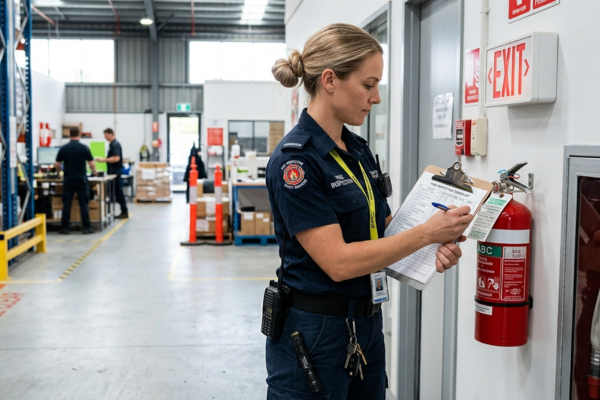
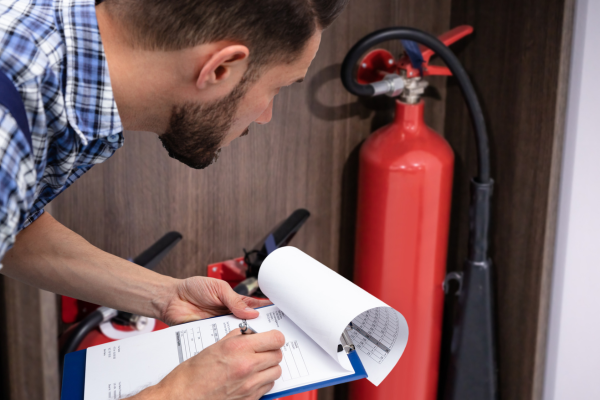
Having the right extinguishers isn't enough; they have to be inspected and serviced on the schedule NFPA 10 requires. Miss any of these and you fail your annual fire inspection:
Spectrum has been providing fire protection services across Orange County since 1987 and is an authorized Amerex distributor; we sell, install, inspect, recharge, and hydrostatically test every commercial extinguisher type. Full details on Spectrum's fire extinguisher service page.
Special spaces that need more than standard extinguishers
Some commercial spaces have hazards that standard ABC extinguishers can't address. Get these wrong and the consequences are worse than a citation:
Server rooms and data centers
Water-based extinguishers and even dry chemicals can destroy electronic equipment. Server rooms need Class C-rated CO2 extinguishers or clean-agent extinguishers (FM-200, NOVEC, or aerosol). For larger data centers, the room itself typically needs a clean-agent suppression system Spectrum is one of the few OC contractors authorized as a Stat-X aerosol dealer. See Spectrum's fire suppression systems page for the full suppression system overview.
Commercial kitchens
Every commercial kitchen needs both a Class K wet chemical extinguisher within 30 feet of cooking equipment AND an NFPA 96-compliant kitchen hood suppression system. The hood system handles the bulk of suppression; the Class K extinguisher handles flare-ups. Cooks and kitchen staff need annual training on Class K technique never water on a grease fire, never standard ABC on grease.
Auto repair, paint operations, and fuel storage
Class B hazards everywhere. ABC dry chemical extinguishers can handle small flammable liquid fires, but high-volume operations may need foam extinguishers or wheeled units (typically 33-pound to 350-pound capacities). Auto body paint booths need both Class B extinguishers and an NFPA 17 spray booth suppression system.
Industrial spaces with combustible metals
Aluminum dust, magnesium machining, lithium battery storage these need Class D extinguishers with the specific agent for the metal involved. Standard ABC will explosively react with some combustible metals. If you have any of these processes, identify them in your fire protection assessment and Class D extinguishers go in based on the specific hazard.
The most-cited extinguisher violations we see
Forty years of OC commercial fire inspections has given us a pattern. The most common citations during a fire marshal walk-through:
- Expired annual service tag most common citation, also easiest to fix. Annual service is required, and the tag must be visible.
- Missing 6-year maintenance documentation happens when buildings change owners and the paperwork doesn't transfer.
- Wrong class for the hazard ABC where Class K should be in kitchens, or no Class B in a flammable liquid storage area.
- Mounting height wrong too low (often from staff repositioning), too high (often in newer construction).
- Travel distance too far extinguishers spaced for the original floor plan, but a renovation moved walls and created a corner that's 90+ feet from the nearest extinguisher.
- Access blocked stored boxes, displays, equipment, or furniture in front of cabinets.
- Tamper seal broken usually means someone removed and replaced the extinguisher without re-tagging it.
- Missing OSHA training documentation employees expected to use extinguishers without the required annual training record.
How to build the right extinguisher inventory for your building
If you're starting from scratch new construction, change of use, major renovation, or just realizing your existing inventory isn't right here's the process we use for OC properties:
- 1. Walk every room and identify the hazard class. Most rooms are Class A. Note specifically where Class B, C, D, or K hazards exist.
- 2. Map travel distances. From every working location, how far is the nearest appropriate extinguisher? Use the floor plan and measure along walking paths, not straight lines.
- 3. Choose extinguisher sizes. Bigger isn't always better, heavier extinguishers must be mounted lower and may be harder for some users. Most general-area placements use 5-pound or 10-pound ABC units. Industrial may need 20-pound or wheeled.
- 4. Plan cabinets and signage. Decide where you need cabinets (vs. wall mounting), the cabinet style, and where signage goes. Match cabinet style to building aesthetics where possible stainless steel for kitchens and industrial, painted steel for retail and offices, fire-rated where code requires.
- 5. Set the service schedule. Establish the monthly visual inspection routine (assign to a building staff member with documentation), and put the annual service on a recurring contract with a California State Fire Marshal-licensed contractor.
- 6. Train the people who will use them. If anyone in your building is designated to use an extinguisher, they need annual OSHA-compliant hands-on training. This is the easiest requirement to miss and one of the most-cited.
How Spectrum helps OC commercial buildings get extinguishers right
As an Orange County fire protection company serving OC since 1987, Spectrum handles every part of the extinguisher requirement assessment, supply, installation, cabinets, signage, annual service, recharge, hydrostatic testing, and the OSHA training your staff needs. We're an authorized Amerex distributor with the full Amerex catalog available, plus Class K, CO2, clean-agent, and specialty units in stock.
We hold California C-16 #886810 and State Fire Marshal E-2293 and A-0448 licenses every extinguisher tag we issue is signed by a SFM-licensed technician and accepted by every OC fire authority. BBB A+ accredited. Need an extinguisher assessment for your OC building?
Call Spectrum at (714) 213-8451 or request a building walk-through through our contact page. We'll inventory your current extinguishers, identify what's missing or non-compliant, supply and install whatever's needed, and put you on a service schedule that keeps you compliant year after year. We cover Anaheim, Garden Grove, Santa Ana, Irvine, Huntington Beach, Fullerton, Newport Beach, and the wider Orange County region.


.png)

.png)

.png)


.png)