

Fire Sprinkler Inspection And Testing in Orange County
Fire Sprinkler Inspection Requirements
Fire sprinkler inspection is not one appointment a year. NFPA 25 sets several different intervals — some items monthly, some quarterly, some annually, some every five years — and the fire marshal who asks for your records expects to see all of them.
Most owners we meet are current on the annual and behind on everything else, usually because nobody explained that the other intervals existed.
Spectrum Fire Protection has inspected and tested commercial fire sprinkler systems across Orange County since 1987. We perform inspections to NFPA 25 and California Title 19, document them in the format your authority having jurisdiction expects, and — because we hold the C-16 license — correct what we find rather than handing you a deficiency list and a phone number.
Not sure what your building is actually due for? Send us your last inspection report and we'll tell you.
Our Fire Sprinkler Services

Fire Sprinkler Repair
Our team provides professional fire sprinkler repair services to address system issues quickly and effectively. If it’s a leaking sprinkler head, broken pipe, malfunctioning control valve, corroded components, or pressure irregularities, our certified technicians identify and fix problems to restore system integrity and reliability.

Fire Sprinkler Design & Installation
Our design and installation services are customized to your building’s layout, occupancy, and fire risk. We engineer and install fire sprinkler systems in accordance with NFPA standards and local codes, ensuring effective services from initial design through final testing and approval.

Five-Year Fire Sprinkler Certification
The five-year fire sprinkler certification is a comprehensive evaluation required by code. This service includes in-depth testing and inspection of system components, documentation, and certification to verify your sprinkler system meets all regulatory and safety standards.
Underground Fire Line Repair
The underground fire line is the part of your system nobody sees, until it fails and the whole system loses supply. We repair leaks, corroded sections, and broken fire mains for commercial properties across Orange County, working to minimize downtime and restore full code-compliant water flow.
How Often Does a Fire Sprinkler System Need Inspection?
This is the question we get most, and the answer is that it depends on the component. A single sprinkler system carries several overlapping schedules. Here is how they generally break down for a typical Orange County commercial property.
Weekly and monthly
Gauges are checked to confirm normal pressure. Control valves are verified in the correct position and secured — how often depends on whether they are locked, sealed, or electrically supervised. Dry pipe and pre-action systems carry additional air pressure and enclosure checks during cold months.
Many owners handle these in-house with a documented log. We can set up that log and train your maintenance staff, or fold the checks into a service agreement.
Quarterly
Waterflow alarm devices are tested to confirm they signal. Supervisory signal devices, including tamper switches, are tested. Hydraulic nameplates, fire department connections, and alarm devices are inspected. On many properties this is the interval that gets missed entirely.
Annually
The full system inspection. Sprinkler heads, piping, fittings, hangers, and seismic bracing are examined. The main drain test is performed and pressures recorded. Control valves are operated through their full travel. Antifreeze solutions are tested where present. This is the inspection most people mean when they say "my annual."
Every five years
The internal inspection. Piping is opened and examined from the inside for corrosion and obstruction, gauges are replaced or recertified, and dry pipe valves are internally inspected. This is a separate requirement from the annual and it is not satisfied by it.
What your specific building needs
The intervals above are the common case. Your actual schedule depends on your system type, your occupancy, your AHJ, and your insurance carrier — any of which can require more than the code minimum. Send us your last report and we will map out what your building is due for and when.
Intervals reflect NFPA 25 as commonly enforced. Adopted editions vary by jurisdiction and change on a three-year cycle. We confirm your requirements against the edition your AHJ currently enforces.
What We Do During Your Annual Inspection

Main Drain Test: Measurement and documentation of static, residual, and restored pressures.
Inspector's test valve activation. Verification of alarm bell operation and confirmation that the signal reaches your monitoring company.
Control valve testing. Operation and inspection of all control valves to confirm they are functional and properly secured against tampering.
Visual system inspection. Examination of sprinkler heads, hangers, and seismic bracing for damage, corrosion, paint, or loading.
Coverage verification. Confirmation that sprinkler heads still provide proper coverage — which changes whenever a tenant moves a wall, drops a ceiling, or adds racking.
Obstruction and damage check. Identification of storage, fixtures, signage, or conditions that would interfere with sprinkler discharge.
Spare head and wrench stock. Verification that required spares are on site and correct for your system — a small item and one of the most frequently cited.
What We Find Most Often
After 39 years of inspections in this county, the deficiency list is remarkably consistent. Knowing what these are lets you fix several before we arrive.
Painted or obstructed sprinkler heads. Usually the result of a tenant's painting contractor working without masking. Painted heads cannot be cleaned — they have to be replaced.
Storage stacked too close to heads. Clearance requirements are routinely violated as warehouses fill up. This is the easiest deficiency to correct and the most likely to recur.
Control valves closed, partly closed, or unsecured. A closed valve means the system cannot perform, and this is one of the more serious findings.
Corrosion at hangers, fittings, and riser trim. Often the visible edge of a larger internal problem.
Missing or illegible signage. Hydraulic nameplates and valve identification.
Missing spare heads and wrench. Frequently cited, easily fixed.
Low or falling static pressure. Sometimes a supply issue, sometimes the first sign of an obstructed main or an underground leak.
If Your System Fails
A deficiency is not a failure of your building. It is what the inspection is for.
When we find issues, you get a written report identifying each one by device and location, with photographs, prioritized by what actually affects system performance versus what is administrative. Inspection reports frequently list a missing spare head cabinet and a seized control valve with identical formatting, and that is not useful to anyone trying to decide what to spend first.
You generally remain in compliance while corrective work is scheduled and progressing. What creates exposure is an uncorrected deficiency with no documented plan behind it.
Because we hold the C-16 license, we correct what we find. You are not coordinating between an inspector who found the problem and a separate contractor to fix it, and you are not paying twice for the same diagnosis.
Your Report And Who Will Ask For It
You receive a completed inspection report in the format your AHJ expects, covering every device tested, the result, and any deficiency identified.
Three parties will eventually ask for it. Your fire authority, at the next inspection or plan review. Your insurance carrier, at renewal or after any claim. And a buyer's inspector, if the property ever changes hands — which is when missing records from years past become an expensive problem during escrow.
We keep your inspection history on file. If you have gaps from a previous contractor, we can often reconstruct part of the record from AHJ files.
How To Prepare
A little preparation shortens the visit and reduces what ends up on the report.
Unlock riser rooms, valve rooms, and any locked mechanical spaces.
Clear access to control valves, the fire department connection, and the inspector's test connection.
Move storage away from sprinkler heads to restore required clearance.
Have your previous inspection report available, along with any deficiency corrections completed since.
Notify tenants that alarms may sound during testing.
Identify someone on site who can authorize the system going briefly out of service.
We handle notification to your monitoring company and, where required, the fire authority, so testing does not generate a dispatch.
Scheduling, Downtime, And Cost
Most annual inspections on single-riser commercial properties are completed in a few hours with minimal disruption. Multi-riser buildings, industrial facilities, and campuses take longer.
The system is briefly out of service during certain tests. For properties that cannot accept that during business hours, we schedule after hours, on weekends, or during low-occupancy periods.
Cost depends on system size, the number of risers and devices, and how many intervals you are catching up on. A building current on its schedule costs less to inspect than one that has not been touched in three years, because the second one is an inspection plus a reconstruction of the record. We quote from your system's actual configuration, and inspection and any corrective work are quoted separately so you can see what you are paying for.
Most properties are better served by a scheduled service agreement than by calling when something comes due. It puts the quarterly and monthly items on a calendar instead of on your memory.
What The Annual Inspection Does Not Cover
Worth stating plainly, because it is the most common and most expensive misunderstanding in this category.
The annual inspection evaluates what a technician can see and operate from outside the system. It does not open the piping. Internal corrosion, obstruction, and gauge accuracy are addressed by the five-year internal inspection, which is a separate requirement on a separate schedule.
A system can pass five consecutive annual inspections and still be significantly obstructed inside. If your building has never had a five-year certification, it is past due regardless of how current your annuals are.
Why Choose US For Fire Sprinkler Services In Orange County
Spectrum Fire Protection provides professional fire sprinkler inspection services for all types of automatic systems—performed in full accordance with NFPA 25 and California Title 19 Regulations.
We offer inspection programs on a quarterly, annual, and five-year basis as required by state regulations, local jurisdictions, and insurance providers. Our certified inspectors help you stay compliant, avoid costly violations, and keep your system ready for any emergency.


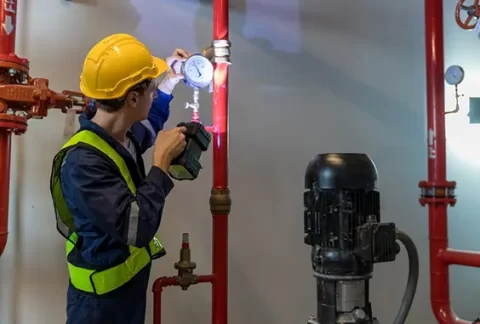
Main Drain Test: Measurement and documentation of static, residual, and restored pressures.
Inspector’s Test Valve Activation: Verification of alarm bell operation and alarm monitoring system performance.
Control Valve Testing: Operation and inspection of all control valves to ensure they are functional and properly secured against tampering.
Visual System Inspection: Examination of sprinkler heads, hangers, and seismic bracing for signs of damage or corrosion.
Coverage Verification: Confirmation that sprinkler heads provide proper coverage throughout the premises.
Obstruction & Damage Check: Identification of any obstructions or conditions that could hinder sprinkler performance.
Trusted by Property Owners
Orange County Fire Sprinkler Inspection Service Areas
At Spectrum Fire Protection, we proudly deliver fire protection services to every corner of Orange County, including:

Placentia
La Palma
Yorba Linda
Stanton
Tustin
Buena Park
Westminster
Orange
Fire Sprinkler Inspections Faqs
How Often Does My Fire Sprinkler System Need To Be Inspected?
Several intervals apply at once — some items monthly, some quarterly, the full system annually, and an internal inspection every five years. Most Orange County commercial properties need at minimum a quarterly and an annual, plus the five-year. Your system type, occupancy, AHJ, and insurance carrier can all require more. Send us your last report and we will map your actual schedule.
What Happens If I Skip a Required Inspection?
Skipping inspections can lead to fire code violations, fines, failed fire marshal inspections, insurance complications, and increased liability in the event of a fire. Practically, the more common consequence is a correction notice with a deadline attached and a scramble to catch up on records.
How Do I Prepare My Building For An Inspection?
Ensure sprinkler heads are unobstructed, valves are accessible, fire department connections are clear, and system rooms are unlocked. Have your previous report available and let tenants know alarms may sound.
Will The Fire Department Be Notified During The Inspection?
Only certain tests require notification. We coordinate with monitoring companies and authorities when needed so testing does not trigger a false alarm response.
Can inspections be done after hours or on weekends?
Yes. We offer flexible scheduling to minimize disruption to tenants and business operations.
What are the most common issues found during inspections?
Obstructed or painted sprinkler heads, closed or leaking valves, corrosion, improper or missing signage, missing spare heads, and low water pressure.
Does my annual inspection cover the five-year requirement?
No. They are separate requirements on separate schedules. The annual inspects the system from the outside; the five-year opens the piping and inspects it internally. In the year your five-year comes due, you need both.
Can you inspect a system another company installed or last serviced?
Yes. We inspect all system types and manufacturers regardless of who installed or last serviced them, including systems with incomplete documentation.
How long does an inspection take?
A few hours for most single-riser commercial properties. Multi-riser buildings, industrial facilities, and multi-building campuses take longer, and catching up on missed intervals adds time.
Do I need a service agreement, or can I just call when something is due?
Either works, but the intervals are the reason most owners end up on an agreement. Remembering an annual is easy; remembering quarterly waterflow testing across a three-building property is where records develop gaps. An agreement puts it on a calendar we track.
Request a Free Quote
.png)

.png)


.png)