

Fire Extinguisher Inspection
Why Choose Us for Fire Extinguisher Inspection in Orange County?
There are many fire extinguisher service companies in Southern California. Here is what sets Spectrum apart from the rest.


State Fire Marshal Licensed E-2293: Our State Fire Marshal license E-2293 authorizes us to inspect, service, and certify every class of portable fire extinguisher in California, including K-class kitchen units.
NFPA 10 Certified Inspection Process: Every inspection follows NFPA 10's full four-tier schedule, monthly, annual, 6-year, and 12-year, so nothing gets missed between visits and nothing gets flagged that doesn't actually need it.
Fast Response Across Orange County: From our Fullerton headquarters, we provide fast response across all 34 Orange County cities for inspections, recharges, and emergency replacement when extinguishers are discharged.
Complete Documentation: Every inspection is followed by full documentation formatted for your fire marshal, insurance carrier, and health department records, not just a tag on the unit.
TRUSTED BY ORANGE COUNTY Business Owners
Our Fire Extinguisher Services

Fire Extinguisher Inspection
Monthly, annual, 6-year, and 12-year service, tracked to the exact interval NFPA 10 requires for each extinguisher type in your building. Every visit ends with documentation formatted for your fire marshal, insurance carrier, and health department, not just a new tag on the unit.

Fire Extinguisher Recharge
Once your extinguisher fails inspection or gets discharged, we recharge it the same day, refilled with the correct genuine agent, pressure-tested, and reassembled with a new tag before it goes back on the wall.

Fire Extinguisher Training
An inspection keeps your extinguishers ready. Training makes sure your team actually knows how to use them, with live, hands-on discharge practice that meets OSHA 1910.157.

Fire Extinguisher Sales
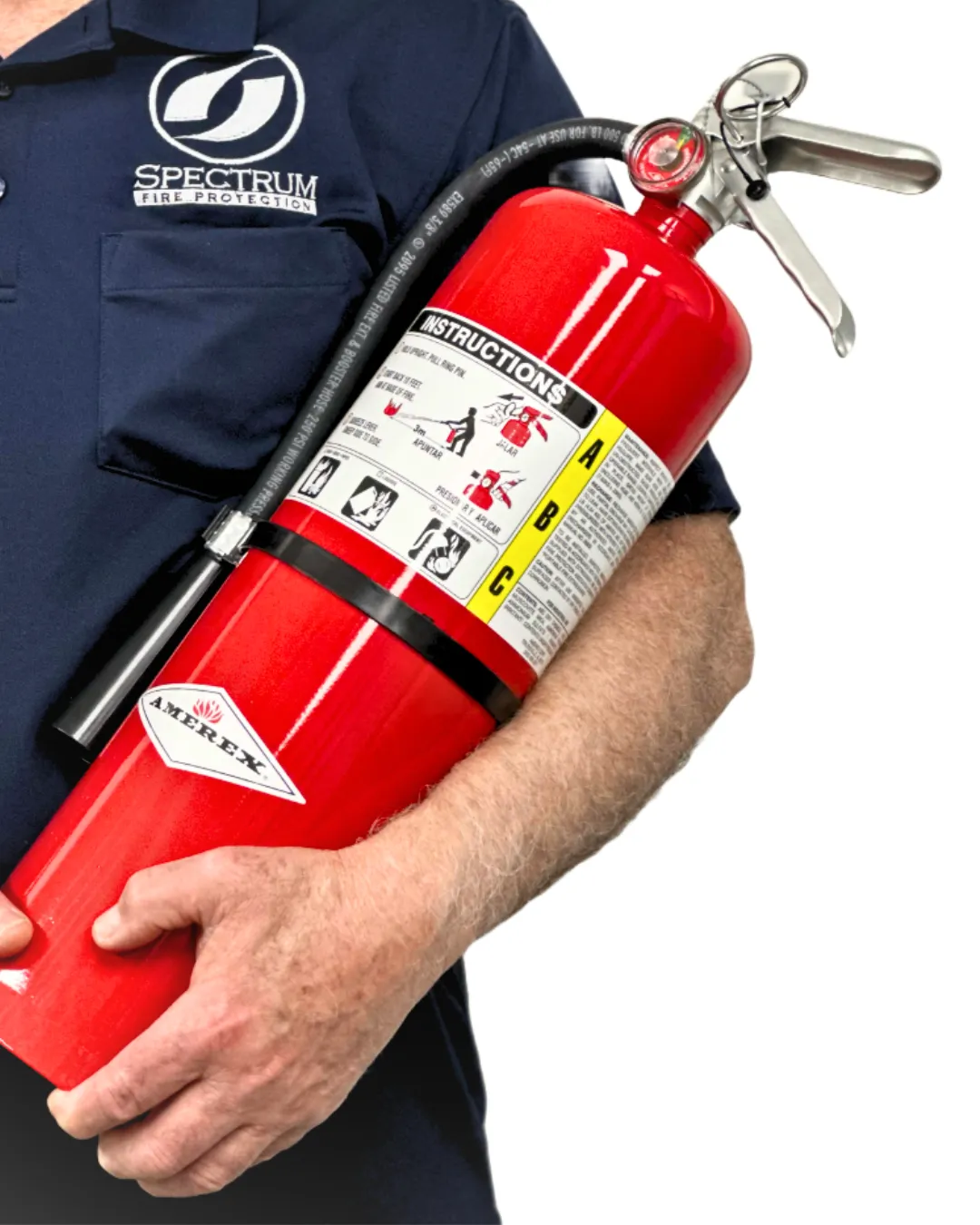
When an inspection turns up a unit that's obsolete, damaged, or the wrong class for its hazard, we supply the replacement on the spot, backed by our status as an Amerex authorized dealer.
Fire Extinguisher Cabinets
A failed inspection sometimes comes down to accessibility, not the extinguisher itself. We install cabinets that keep units visible and within NFPA 10's required mounting and clearance.
What We Actually Check, Class by Class
A monthly glance treats every extinguisher the same. A real inspection doesn't, because each class fails in a different way, and the checks that catch one class's problem won't catch another's.
Multi-Purpose Dry Chemical: On inspection, we check gauge pressure, seal condition, and physical wear on these units covering ordinary combustibles, flammable liquids, and electrical fires, the class found in nearly every office, warehouse, and retail space.
Kitchen (K-Class) Fire Extinguisher: These wet chemical units see heavier use than a typical office extinguisher, so inspection includes a closer look at the discharge mechanism and agent level, required in every commercial kitchen handling cooking oils and fats.
Clean Agent: Because clean agent units don't always show pressure loss on a standard gauge, inspection includes a weight check, critical for units protecting electronics, server rooms, and lab equipment where dry chemical residue would cause damage.
Combustible Metal: Inspection confirms the agent type still matches the specific metal hazard it was placed for, since a mismatched agent on a magnesium, sodium, or titanium fire can make things worse, not better.
Water Mist and Foam: These specialty units, common in hospitals and medical facilities, follow the same NFPA 10 inspection schedule as other classes, with particular attention paid to their specific hydrostatic testing interval.
What Our Fire Extinguisher Inspection Covers
NFPA 10 sets four mandatory service intervals for every portable fire extinguisher. Missing any one of them, not just the annual visit, is what actually causes failed inspections and voided coverage.
Monthly Visual Inspection: A quick check that the extinguisher is in place, the pressure gauge reads in the green zone, the pull pin and tamper seal are intact, and the unit is accessible and unobstructed. Building staff can perform this themselves, or we can include it as part of an ongoing service plan
Annual Maintenance Inspection: A full inspection performed by our certified technicians: internal and external condition, weight verification, hose and nozzle check, and a new maintenance tag documenting the month, year, and technician of record. This is the visit that actually satisfies your fire marshal and insurance carrier.
6-Year Internal Examination: For stored-pressure extinguishers on the 12-year hydrostatic cycle, we discharge the unit, remove the valve, and inspect the cylinder interior for corrosion, pitting, or chemical caking, then recharge and reassemble with a new 6-year label.
Hydrostatic Testing: Most stored-pressure dry chemical extinguishers are tested every 12 years. CO2, water-based, wet chemical, and stainless steel units are on a shorter 5-year cycle. We track each unit's individual manufacture date so nothing is tested early or missed.
Orange County fire PROTECTION Service Areas
We proudly deliver fire protection services to every corner of Orange County, including:

Brea, OC
Cypress, OC
Garden Grove, OC
Costa Mesa, OC
Placentia,OC
La Palma, OC
Yorba Linda, OC
Stanton, OC
Tustin, OC
Buena Park,OC
Westminster, OC
Orange, OC
Fire extinguisher services faqs
How Often Must I Inspect My Fire Extinguishers?
NFPA 10 requires a monthly visual inspection, which building staff can perform without certification, plus a full annual maintenance inspection by a certified technician. Depending on the extinguisher type, a 6-year internal examination and a 5-year or 12-year hydrostatic test also apply.
What's the Difference Between Monthly and Annual Inspections?
The monthly check is a quick visual confirmation: gauge reading, pin and seal intact, accessibility. The annual inspection is a full technician-performed service covering internal and external condition, weight verification, and a new maintenance tag, the visit that actually satisfies your fire marshal and insurance carrier.
What If My Extinguisher Fails Inspection?
A failed unit is either recharged, repaired, or replaced on the spot where possible. If a cylinder fails hydrostatic testing, it can't be repaired and is removed from service; for smaller units, replacement is usually more cost-effective than testing fees at that point.
Who Is Legally Allowed to Inspect Fire Extinguishers in California?
Monthly visual checks can be performed by building staff without a license. Any company charging a fee to perform annual maintenance, 6-year, or hydrostatic service must hold a State Fire Marshal license or CSLB C-16 license, which is why it's worth confirming a provider's license before signing a service agreement.
Request a Free Quote
.png)

.png)


.png)