

Five-Year Fire Sprinkler Certification in Orange County
Orange County's Trusted Five-Year Certification Specialists
Most building owners find out they need a five-year certification the hard way: a fire marshal walks the property, asks for the report, and there isn’t one.
The confusion is understandable. Your sprinkler system gets inspected every year, the paperwork comes back clean, and it is reasonable to assume you are covered. You are not. The annual NFPA 25 inspection and the five-year certification are two separate requirements, and passing one has no bearing on the other. The five-year certification goes inside the system: piping is opened and internally inspected, gauges are replaced or recertified, and components that cannot be evaluated from the outside are examined directly.
Spectrum Fire Protection has performed five-year certifications for Orange County commercial and industrial properties since 1987. We handle the full scope: internal obstruction investigation, gauge replacement, valve and alarm testing, deficiency documentation, corrective repairs, and final certification paperwork your AHJ and your insurance carrier will accept.
If your system is more than five years old and has never had a five-year certification, it is past due right now. We will review your records and confirm your actual due date at no cost.
TRUSTED BY ORANGE COUNTY Business Owners
Our Fire Sprinkler Services

Fire Sprinkler Repair
Our team provides professional fire sprinkler repair services to address system issues quickly and effectively. If it’s a leaking sprinkler head, broken pipe, malfunctioning control valve, corroded components, or pressure irregularities, our certified technicians identify and fix problems to restore system integrity and reliability.

Fire Sprinkler Design & Installation
Our design and installation services are customized to your building’s layout, occupancy, and fire risk. We engineer and install fire sprinkler systems in accordance with NFPA standards and local codes, ensuring effective services from initial design through final testing and approval.

Fire Sprinkler Inspection & Testing
Routine inspection and testing are essential for system performance and compliance. We perform required quarterly and annual inspections, main drain tests, valve checks, and alarm testing, with detailed reporting to meet NFPA 25 and local authority requirements.
Underground Fire Line Repair
The underground fire line is the part of your system nobody sees, until it fails and the whole system loses supply. We repair leaks, corroded sections, and broken fire mains for commercial properties across Orange County, working to minimize downtime and restore full code-compliant water flow.
What Our Five-Year Certification Includes
Here is exactly what our specialists do on site.

Run the required flow and alarm tests: a main drain test recording static, residual, and restored pressures, activation of the inspector's test valve to verify the alarm bell and monitoring, and a backflush of the check valve at the fire department connection.
Operate and test all control valves, ensuring they are functional and secured from tampering.
Visually inspect the system pipes, fittings, sprinkler heads, hangers, and seismic bracing for corrosion, damage, and obstructions, and confirm proper sprinkler coverage throughout the premises.
Verify head testing and signage: that periodic UL laboratory testing of sprinkler heads is current and that all required signage is posted per your local jurisdiction.
Document everything with state-approved reports (AES-2) or jurisdiction-specific forms, plus a compliance report for your records.
Flexible Scheduling with Transparent Pricing
Downtime Duration: Most commercial properties see a 4-to-8-hour window during the internal inspection. Larger industrial facilities and multi-building campuses run longer.
Scheduling Options: We schedule after hours, on weekends, or during low-occupancy periods for properties that cannot accept downtime during business hours. Where required, we coordinate the impairment notification with your AHJ and your fire alarm monitoring company before the system goes down.
Documentation Timeline: Laboratory testing of any submitted sprinkler samples runs seven to ten business days. Final certification documentation is typically delivered within two weeks of the on-site work.
Transparent Pricing: Cost depends on system size, the number of risers, how many inspection points have to be opened, and whether deficiencies are found. A single-riser commercial building sits at the low end; a multi-building campus with several risers and standpipes sits well above it. We quote from your system's actual configuration rather than a flat rate, and we quote the certification and any corrective work separately so you can see what you are paying for.
Certification by System Type
Different system types carry different five-year requirements. What your certification involves depends on what you have.
Wet pipe systems. The most common configuration and the most straightforward certification. The internal inspection is performed at a flushing connection on a main and at a branch line end.
Dry pipe systems. In addition to the internal piping inspection, the dry pipe valve itself is opened and internally inspected, and the trip test requirements are more involved than on a wet system.
Pre-action systems. Common in data centers, healthcare facilities, and other sensitive environments. Certification covers the valve internals plus verification that the detection and release sequence still performs as designed.
Deluge systems. Used in high-hazard industrial settings. Open-head systems require strainer inspection and confirmation that discharge devices remain unobstructed.
Antifreeze systems. Antifreeze solutions require periodic testing of solution concentration in addition to the standard certification scope.
Why Orange County Chooses Us for Five-Year Certification
Five-year certification is specialized work that not every fire protection contractor performs correctly. Many contractors offer the service but lack the equipment, lab partnerships, or technical experience to do it right. Here is why our certifications are different.

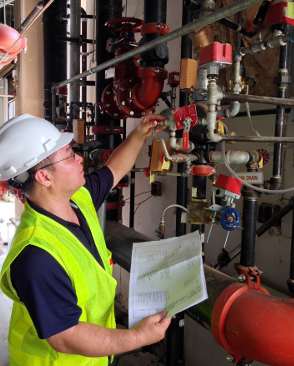
Title 19 Specialists: We have performed California Title 19 certifications since the regulation took its current form. Sam K. personally oversees major certification projects and understands every detail of the requirement.
UL-Accredited Lab Partners: Our sprinkler head sample testing is performed by UL-accredited laboratories with documented chain-of-custody. Insurance carriers and fire authorities accept our lab partners without question.
AHJ-Accepted Documentation: Our certification reports are accepted by OCFA, Anaheim Fire & Rescue, and every other Orange County fire authority. We know what each AHJ requires and provide documentation that passes review the first time.
State Fire Marshal Experienced: Our team holds California State Fire Marshal licenses (E-2293 and A-0448) in addition to our CSLB C-16 #886810. We bring the same standard of credentialed work to every certification.
Five-Year Certification Service Areas in Orange County
We proudly deliver fire sprinkler services to every corner of Orange County, including:

Brea, OC
Cypress, OC
Santa Ana, OC
Irvine,OC
Huntington Beach, OC
Garden Grove, OC
Costa Mesa, OC
Placentia,OC
La Palma, OC
Yorba Linda, OC
Stanton, OC
Tustin, OC
Buena Park,OC
Westminster, OC
Orange, OC
Frequently Asked Questions
Does the five-year certification replace my annual inspection?
No. Both are required, and they run on separate schedules. In the year your five-year certification comes due, you need both. The annual inspection continues every year regardless.
How do I know if my five-year certification is due?
Your system is due five years from the date of the most recent certification report. Three situations account for nearly every overdue system we find:
No prior certification on record. If the building has never had one, it is past due today regardless of how current your annual inspections are.
The building changed hands. Certification records frequently fail to transfer during a sale. The new owner inherits the obligation without inheriting the paperwork, and the gap surfaces at the next fire marshal visit.
A new system that has hit the five-year mark. Systems installed within the last five years come due at five years from the acceptance date. New construction does not exempt a building, it just delays the first certification.
If you are not sure, send us your most recent inspection report. We can usually determine your status from it, and where records are missing we can often reconstruct the history from AHJ files.
What happens if you find problems during the certification?
Most systems that have not been internally inspected in five years have something. That is the point of the requirement, and finding a problem is not a compliance failure.
When we find deficiencies such as corroded piping, obstructed mains, a failed sample head, or a seized control valve, we document them with photographs and, where applicable, laboratory results. You receive a written corrective action plan with repairs prioritized by what actually affects system performance rather than presented as an undifferentiated list.
You remain in compliance while corrective work is underway, provided the work is scheduled and progressing. Most deficiencies resolve within 30 to 90 days. We complete the corrective work, reinspect, and issue final certification.
Because we hold the C-16 license, the repairs and the certification come from the same contractor. You are not coordinating between an inspector who found the problem and a separate outfit to fix it, and you are not paying twice for the same diagnosis.
How long does a five-year certification take?
Most on-site work completes within four to eight hours for typical commercial properties, depending on system size and complexity. Larger industrial facilities or multi-building campuses may require multiple days. Lab testing of sample sprinkler heads typically takes seven to ten business days after collection. Final certification documentation is usually delivered within two weeks of the on-site work.
For properties that cannot accept downtime, we schedule certifications during after-hours, weekends, or low-occupancy periods to minimize business disruption.
What if I have never had a certification and the fire marshal is already asking?
Call us. Active AHJ pressure changes the sequencing. The priority becomes getting the inspection scheduled and documented so you have a defensible position while any corrective work proceeds. Fire authorities are generally reasonable with owners who have a certification scheduled and a plan in writing.
Can you certify a system another company installed or previously inspected?
Yes. We certify systems regardless of who installed or last serviced them, including systems with incomplete or missing documentation.
Request a Free Quote
.png)

.png)


.png)