

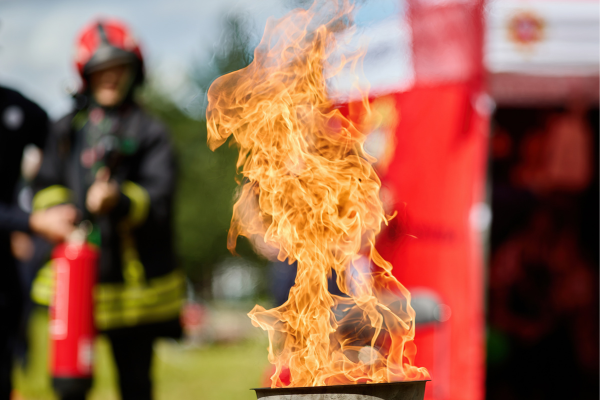
If you employ workers in California, fire safety is not optional. It is the law. The state has built one of the most comprehensive fire safety regulatory frameworks in the country, layered across federal OSHA standards, California's own Cal/OSHA rules, national NFPA codes, and local fire authority requirements that vary city by city across Orange County and the rest of the state.
Most California employers do not realize how many separate laws apply to their workplace until something goes wrong. A failed inspection, an employee injury, or a small fire that should have been preventable suddenly puts them in front of investigators who want to know why the law was not followed. By that point, the answer rarely matters. The penalties have already started.
This guide breaks down every fire safety law that applies to California employers in plain language. We explain what each agency requires, what the most common violations look like, what the penalties actually cost, and what you need to do to stay protected. After 39 years of working with California businesses on fire protection compliance, we have seen every type of violation and every type of penalty. This article shares what we have learned so you do not have to learn it the hard way.
Why Fire Safety Compliance Is Not Optional in California
California treats workplace fire safety differently than most other states. Three factors explain why.
First, California adopted Cal/OSHA in 1973, giving the state authority to set workplace safety standards stricter than federal OSHA. California regularly uses this authority to impose additional fire safety requirements that federal rules do not require, and Cal/OSHA inspectors enforce these rules across every industry from restaurants to manufacturing.
Second, California's geography creates extreme fire risk. The state experiences Santa Ana wind events, wildland-urban interface fire zones, drought conditions, and seismic activity that can damage fire protection systems. Workplaces in California must account for these risks in ways that workplaces in other states do not.
Third, California's enforcement is aggressive. Cal/OSHA conducts both scheduled and surprise inspections. Local fire authorities perform annual occupancy inspections. Insurance carriers require documented compliance. Plaintiff attorneys watch for compliance failures as evidence in injury cases. Compliance is not just about avoiding fines; it is about protecting your business from cascading legal and financial consequences.
Fire safety compliance in California is not about ticking boxes for a single regulator. It is about meeting the requirements of multiple regulators at the same time, with each one having its own forms, deadlines, and penalty structure.
The Three Layers of Fire Safety Law Every Employer Must Know
Every California workplace must comply with three layers of fire safety law simultaneously. Most employers focus on one layer and miss the other two, which is where violations happen.
Layer 1: Federal OSHA Standards
The Occupational Safety and Health Administration sets the baseline federal requirements. The relevant section is 29 CFR 1910 Subpart L (Fire Protection), which covers fire brigades, fire detection, fire suppression, and fire prevention plans. Every employer in the country must meet these standards.
Layer 2: California Cal/OSHA Requirements
California adds its own requirements through Title 8 of the California Code of Regulations. Cal/OSHA Title 8 is generally stricter than federal OSHA, with more detailed requirements for fire prevention plans, emergency action plans, fire extinguisher training, and exit route maintenance. California also has industry-specific requirements that go beyond federal standards.
Layer 3: NFPA Standards and Local Fire Code
The National Fire Protection Association (NFPA) publishes the technical standards that every fire authority enforces. NFPA standards cover the design, installation, testing, and maintenance of fire protection systems. Local fire authorities, including the Orange County Fire Authority (OCFA) and independent city fire departments, enforce these standards through plan reviews, permits, and annual inspections of your property.
All three layers apply simultaneously. Compliance with federal OSHA does not satisfy Cal/OSHA. Cal/OSHA compliance does not satisfy NFPA. NFPA compliance does not satisfy your local fire marshal. Every California employer must meet all three.
Cal/OSHA Fire Safety Requirements (The Big One)
Cal/OSHA Title 8 is the law most California employers underestimate. Federal OSHA gets more attention nationally, but Cal/OSHA is the agency that will actually inspect your workplace and issue the citations. Here are the requirements every employer needs to know.
Fire Prevention Plans (Section 3221)
Every employer with more than 10 employees must have a written fire prevention plan. The plan must identify all major fire hazards, control procedures for flammable materials, names of personnel responsible for maintaining fire prevention equipment, and procedures for controlling accumulations of flammable waste materials.
The plan must be available to employees for review and must be communicated to employees when first hired and whenever the plan changes. Cal/OSHA inspectors routinely ask to see the written plan during inspections. No plan, automatic citation.
Emergency Action Plans (Section 3220)
Every employer must have a written emergency action plan that includes procedures for emergency evacuation, procedures for employees who remain to operate critical operations, procedures to account for all employees after evacuation, rescue and medical duties for designated employees, the preferred method for reporting fires and other emergencies, and names of persons to contact for further information.
Employers with 10 or fewer employees can communicate the plan orally rather than in writing, but it still must exist and be communicated. Most violations happen because the employer has never created or formally communicated this plan.
Fire Extinguisher Training (Section 6151)
If your workplace has fire extinguishers and you expect any employee to use them, those employees must be trained in fire extinguisher use upon initial assignment and at least annually thereafter. The training must cover the principles of fire extinguisher use and the hazards of incipient stage firefighting. Spectrum Fire Protection provides this required training for California employers.
Exit Routes (Section 3215)
California requires unobstructed exit routes from every workplace. Doors must remain unlocked from the inside during business hours. Exit signs must be visible from every point in the workplace. The path to the exit must be free of obstructions, including boxes, equipment, and storage. Exit routes must lead directly to a safe area outside the building.
This is the most cited Cal/OSHA fire safety violation in California. Inspectors look specifically for blocked exits, locked exit doors, dim or missing exit signs, and storage in exit pathways. Many employers do not realize that an exit blocked even temporarily for stocking or moving equipment is a violation.
Fire Detection and Notification Systems
Workplaces with fire alarm or detection systems must maintain those systems in proper working order. Systems must be tested in accordance with manufacturer specifications and applicable NFPA standards. Service records must be available for inspection. False alarms, system failures, and missing service records are all citable.
NFPA Standards Every California Employer Should Recognize
Cal/OSHA tells you what your obligations are as an employer. NFPA tells you the technical standards your fire protection equipment must meet. These are the NFPA standards that apply to almost every California workplace.
NFPA 10: Portable Fire Extinguishers
Sets the rules for fire extinguisher selection, placement, mounting height, monthly visual inspections, annual professional inspections, hydrostatic testing schedules (5-year and 12-year cycles), and recordkeeping. Every California workplace with extinguishers must follow NFPA 10, and inspectors check tags and documentation at every visit.
NFPA 13: Installation of Sprinkler Systems
Covers the design and installation of automatic fire sprinkler systems. If your building has sprinklers, the original installation must meet NFPA 13 and any modifications must also comply. Sprinkler system work in California requires a CSLB C-16 licensed contractor.
NFPA 25: Inspection, Testing, and Maintenance of Water-Based Fire Protection Systems
Sets the rules for ongoing inspection, testing, and maintenance of your existing sprinkler system. Includes weekly, monthly, quarterly, semi-annual, annual, and 5-year inspection requirements depending on system components. This is the standard that drives most ongoing sprinkler service work.
NFPA 72: National Fire Alarm and Signaling Code
Covers the design, installation, testing, and maintenance of fire alarm systems. If your workplace has a fire alarm, NFPA 72 applies to its ongoing maintenance and the documentation required after each inspection.
NFPA 17A and UL 300: Commercial Kitchen Hood Suppression
Required for every commercial kitchen with a Type I hood. Covers the wet chemical suppression system installed above commercial cooking equipment. Service is required every 6 months, and the system must meet UL 300 standards. Required for restaurants, hotels, schools, hospitals, and any other facility with commercial cooking operations.
Local Fire Code Requirements (Orange County Focus)
Federal and state law set the baseline. Local fire authorities enforce it. In Orange County, this is where the most active enforcement happens, and where understanding your specific city's requirements matters most.
OCFA Member Cities
Most Orange County cities fall under the Orange County Fire Authority (OCFA). OCFA handles plan reviews, permits, annual inspections, and code enforcement for 23 member cities. Their inspection program covers commercial, industrial, educational, and multi-family buildings on a recurring schedule.
Independent Fire Departments
Eight Orange County cities operate their own independent fire departments rather than using OCFA: Anaheim, Costa Mesa, Fullerton, Garden Grove, Huntington Beach, Newport Beach, Orange (uses OCFA), and Santa Ana. Each of these departments has its own permit process, plan review standards, and inspection schedule. Contractors and property owners working in these cities must follow the local department's specific procedures.
Annual Fire Inspections
Every commercial, industrial, and multi-family property in Orange County receives an annual fire safety inspection from either OCFA or the local city fire department. The inspector checks fire extinguishers, sprinkler systems, alarm systems, exits, exit signs, kitchen suppression (if applicable), and general code compliance. Findings are documented in writing and require correction within specified timeframes.
Operating Permits
Many commercial activities in Orange County require fire department operating permits, including hot work, hazardous materials storage, places of public assembly, and Christmas tree lots. Operating without a required permit is a separate violation from any underlying fire code violation.
The 7 Most Common Fire Safety Violations Cal/OSHA Cites
After 39 years of working with California employers on compliance, these are the violations we see Cal/OSHA cite most often. Each one is preventable with proper planning and maintenance.
1. Missing or Expired Fire Extinguisher Tags
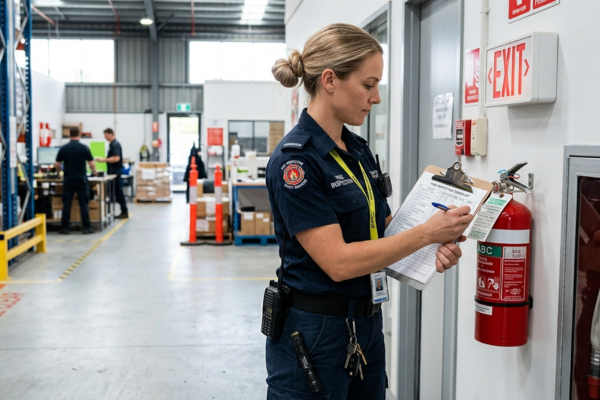
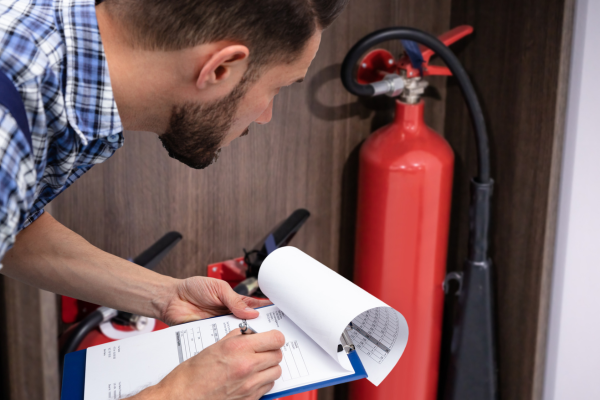
Every fire extinguisher must display a current inspection tag with the date of the most recent professional inspection. Missing tags, expired tags, or tags from an unlicensed contractor all result in citations. This is the single most common violation we see, and it is the easiest to fix with regular annual fire extinguisher service.
2. Blocked or Obstructed Exits
Cal/OSHA inspectors specifically check that exit paths are clear. Boxes stacked in front of exits, equipment blocking exit doors, locked exit doors during business hours, and storage in exit corridors are all common violations. This is particularly common in restaurants, warehouses, and retail spaces where storage pressure leads to creeping accumulation in exit pathways.
3. Missing Written Emergency Action Plans
Many employers verbally tell employees what to do during an emergency but never put it in writing. Cal/OSHA requires written plans for employers with more than 10 employees, and the inspector will ask to see the written document. Verbal communication does not satisfy the requirement.
4. Untrained Employees
Even when fire extinguishers and emergency plans are in place, employers often fail to train employees properly. Cal/OSHA requires annual training, and there must be documented evidence that training occurred. No training records means the citation stands even if training actually happened.
5. Failed or Overdue Sprinkler System Inspections
Sprinkler systems require multiple types of inspections on different schedules per NFPA 25. Quarterly inspections, annual inspections, and 5-year internal inspections all must be performed by qualified contractors and documented. Properties that have not had their required 5-year inspection are commonly cited.
6. Missing Fire Alarm System Certifications
Fire alarm systems must be tested annually and the testing must be documented with a certified inspection report. Many properties have functioning alarm systems but cannot produce current certification paperwork, which results in citations.
7. Kitchen Hood Suppression Deficiencies
Commercial kitchens are required to have their UL 300 hood suppression system serviced every 6 months. K-class extinguishers are required to be inspected annually. Missing semi-annual hood service, expired K-class tags, or grease accumulation in the hood and duct system are commonly cited in restaurant inspections by both fire authorities and health departments.
Penalties for Fire Safety Violations in California
Penalties for fire safety violations come in several forms. Some are direct fines. Some are operational consequences. Some create cascading effects that extend far beyond the original violation.
Cal/OSHA Citation Levels
Cal/OSHA classifies violations into four categories with escalating penalties. Regulatory violations are the lowest level, used for paperwork and recordkeeping failures, with penalties up to about $13,000 per violation. General violations cover most fire safety violations and carry similar maximum penalties.
Serious violations occur when there is a substantial probability that death or serious physical harm could result. These penalties can exceed $25,000 per violation. Willful violations, where the employer knew about the requirement and chose not to comply, can result in penalties up to $158,000 per violation. Repeat violations multiply existing penalties significantly.
Local Fire Authority Penalties
OCFA and city fire departments can impose their own penalties for code violations, including administrative citations, daily compounding fines until correction, and notices to abate that can ultimately close your business if violations are not corrected within the specified timeframe.
Insurance Consequences
Commercial property insurance carriers require fire safety compliance as a condition of coverage. A failed inspection or documented violation can result in policy non-renewal, premium increases, or claim denials if a fire occurs while violations are outstanding. The insurance consequences often dwarf the direct fines.
Operational Consequences
Fire authorities can issue stop work orders, deny occupancy permits, and close businesses with active uncorrected violations. For restaurants and hotels operating in Anaheim's Resort District or any high-occupancy environment, even a temporary closure during peak season can cost more than years of compliance investment.
Criminal Liability
In serious cases involving willful violations that result in worker injury or death, prosecutors can pursue criminal charges against business owners and managers. California has prosecuted employers under criminal statutes for fire safety violations that resulted in fatalities. These cases are rare but career-ending when they occur.
How to Pass Every Fire Safety Inspection
California's compliance requirements look overwhelming when listed together, but the actual work of staying compliant is manageable when broken into a system. Here is what we recommend to every California employer.
Establish an Annual Compliance Calendar
Most fire safety requirements are recurring. Annual fire extinguisher inspections, semi-annual kitchen hood service, quarterly sprinkler inspections, annual fire alarm testing, and annual employee training all need to be scheduled and documented. Build a calendar at the start of each year that captures every recurring requirement.
Use Licensed, Qualified Contractors
Some fire safety work in California legally requires a contractor with specific licenses. Fire sprinkler work requires CSLB C-16. Electrical fire alarm work requires C-10. Fire extinguisher certification requires State Fire Marshal E-2293. Kitchen suppression requires State Fire Marshal A-0448. Using an unlicensed contractor produces work that fire inspectors will reject and that CSLB can investigate as illegal contracting.
Document Everything
Every inspection, every service visit, every training session, and every corrective action must be documented in writing. Keep records on-site and accessible. Cal/OSHA inspectors, fire authorities, and insurance carriers all expect to see records on demand. Verbal claims that maintenance happened are not sufficient if records are missing.
Train Employees and Document the Training
Annual fire extinguisher training and emergency action plan training are required. Both training events must be documented with attendee names, training dates, content covered, and trainer credentials. Without documentation, the training does not count for compliance purposes.
Maintain Active Vendor Relationships
Working with the same qualified fire protection contractor over time creates institutional knowledge about your specific property. The contractor knows your equipment, your inspection history, your local fire authority's expectations, and your renewal cycles. Spectrum maintains long-term service relationships with Orange County employers across every commercial property type, including hotels, restaurants, manufacturing facilities, healthcare properties, and offices.
Industries With Extra Fire Safety Requirements
Beyond the baseline requirements that apply to every California employer, several industries face additional fire safety obligations specific to their operations.
Restaurants and Food Service
Commercial kitchens require UL 300 hood suppression systems serviced every 6 months, K-class fire extinguishers inspected annually, and grease duct cleaning on a regular schedule. The Orange County Health Department also inspects fire safety as part of food service permitting. Restaurants face dual enforcement from fire authorities and health departments.
Healthcare Facilities
Hospitals, surgical centers, and skilled nursing facilities face Joint Commission requirements, CMS regulations, California Department of Public Health oversight, and stricter NFPA 99 standards in addition to general fire safety requirements. Healthcare fire protection is among the most heavily regulated environments in the state.
Schools and Childcare
Schools have additional requirements for evacuation drills, fire safety education, and protection of vulnerable populations. California requires schools to conduct multiple fire drills annually with documented results. Childcare facilities have similar requirements with additional staff-to-child ratios during evacuation procedures.
Manufacturing and Industrial
Manufacturing facilities often handle flammable liquids, combustible dusts, hot work operations, and hazardous chemicals that require specialized fire protection systems and permits. Industrial fire pumps, large-scale sprinkler systems, and specialty extinguishers (Class D for metals, clean agent for sensitive equipment) often apply.
Hotels and Hospitality
Hotels in Anaheim's Resort District and throughout California face strict requirements for guest room smoke detectors, corridor fire alarm systems, kitchen suppression in restaurant operations, and emergency lighting throughout guest areas. High-occupancy assembly venues like Honda Center and Angel Stadium have additional egress and notification requirements.
High-Occupancy Assembly
Convention centers, theaters, concert venues, and stadiums face the strictest fire codes because of occupant load. The Anaheim Convention Center, at 1.1 million square feet, operates under fire code requirements that smaller properties never encounter, including dedicated fire command rooms, specialized notification systems, and crowd management protocols.
Why You Need a Licensed Fire Protection Contractor
Fire safety compliance involves work that California law specifically requires licensed contractors to perform. Hiring an unlicensed handyman, a general contractor without fire protection credentials, or a vendor from outside California for fire protection work creates legal exposure on top of the underlying fire safety risk.
California License Requirements
Fire protection work in California requires specific Contractor's State License Board (CSLB) classifications. The C-16 Fire Protection Contractor license is required for fire sprinkler design, installation, and modification. The C-10 Electrical Contractor license is required for fire alarm electrical work.
State Fire Marshal licenses are required for fire extinguisher servicing and certification (E-2293 for portable extinguishers) and for kitchen hood suppression systems (A-0448). These are separate from CSLB licenses and serve different regulatory purposes.
Verifying Licenses
Before hiring any fire protection contractor, verify their licenses are active by checking the CSLB license check tool and the California State Fire Marshal's licensee database. Licensed contractors should provide license numbers in their contracts and on invoices. If a contractor refuses to provide license information or you cannot verify the license is active, find a different contractor.
What a Licensed Contractor Should Provide
A licensed fire protection contractor like Spectrum Fire Protection provides the technical work, the required documentation for fire authorities and insurance carriers, ongoing tracking of inspection due dates, and continuity of service across multiple recurring requirements. The right contractor becomes a partner in your compliance program rather than just a vendor for individual jobs.
Frequently Asked Questions
How often must California employers update their fire prevention plan?
The plan must be reviewed and updated whenever there are changes to operations that affect fire safety, when new equipment is added, when building modifications occur, or when employees are added or moved into roles with fire safety responsibilities. Cal/OSHA recommends an annual review even if no changes have occurred.
What records must employers keep for fire safety inspections?
Records of all fire extinguisher inspections (annual professional, monthly visual), sprinkler inspections and testing reports, fire alarm test reports, kitchen hood suppression service records, employee training attendance and content, emergency action plan documentation, and any correction notices from fire authorities and the actions taken to correct them. Records must be available on demand and typically must be retained for the life of the equipment plus a minimum of three years.
Do small businesses with fewer than 10 employees have to follow the same rules?
Small businesses are exempt from some written documentation requirements (the emergency action plan can be communicated verbally, for example), but all the actual fire safety requirements still apply. Fire extinguishers still need annual inspection. Exits still must be clear. Sprinkler systems still need NFPA 25 inspections. Smaller employers face the same regulatory requirements with slightly less paperwork burden.
What happens if a fire authority finds violations during an inspection?
The inspector documents the violations in a written report and gives the property a specified time to correct them, typically 30 to 90 days depending on severity. Failure to correct within the timeframe results in escalating actions including administrative citations, daily fines, or notices to abate that can close the business. Serious life-safety violations can result in immediate closure orders.
Can I do my own fire extinguisher inspections to save money?
Monthly visual inspections by your own staff are required and acceptable. Annual professional inspections, hydrostatic testing, recharging, and certification work must be performed by a State Fire Marshal licensed contractor. Doing the certification work yourself is illegal and the resulting tags would not be accepted by any fire authority.
What if I disagree with a Cal/OSHA citation?
Employers have the right to appeal Cal/OSHA citations within 15 working days of receipt. The appeal process involves an administrative hearing where the employer can challenge the citation's findings or proposed penalty. Many employers also negotiate informal settlements with Cal/OSHA before formal appeal hearings.
How quickly should I fix a fire safety violation?
Fix violations immediately when possible, especially anything affecting employee egress or fire suppression capability. For violations that require contractor work, schedule the work as soon as practical and document the scheduling in case the inspector returns before correction is complete. Inspectors generally extend correction periods for employers who can demonstrate active progress.
The Bottom Line for California Employers
California fire safety compliance is not a checklist you complete once. It is an ongoing program that requires planning, qualified contractors, regular maintenance, and documented records across multiple regulatory frameworks. The penalties for getting it wrong range from administrative fines to business closure to criminal liability in worst-case incidents.
The good news is that compliance is achievable with the right approach. Most California employers who maintain working relationships with qualified licensed fire protection contractors stay in compliance year after year with minimal disruption to operations. The contractors handle the technical work, track the deadlines, and provide the documentation. The employer focuses on running the business.
If you are unsure whether your California workplace meets current fire safety requirements, the safest move is a professional compliance review. Contact Spectrum Fire Protection for a free consultation. Sam K. and our team will walk through your existing fire protection equipment, identify any compliance gaps, and provide a written assessment with recommended corrective actions. Call (714) 213-8451 or schedule a consultation online.


.png)

.png)

.png)


.png)