

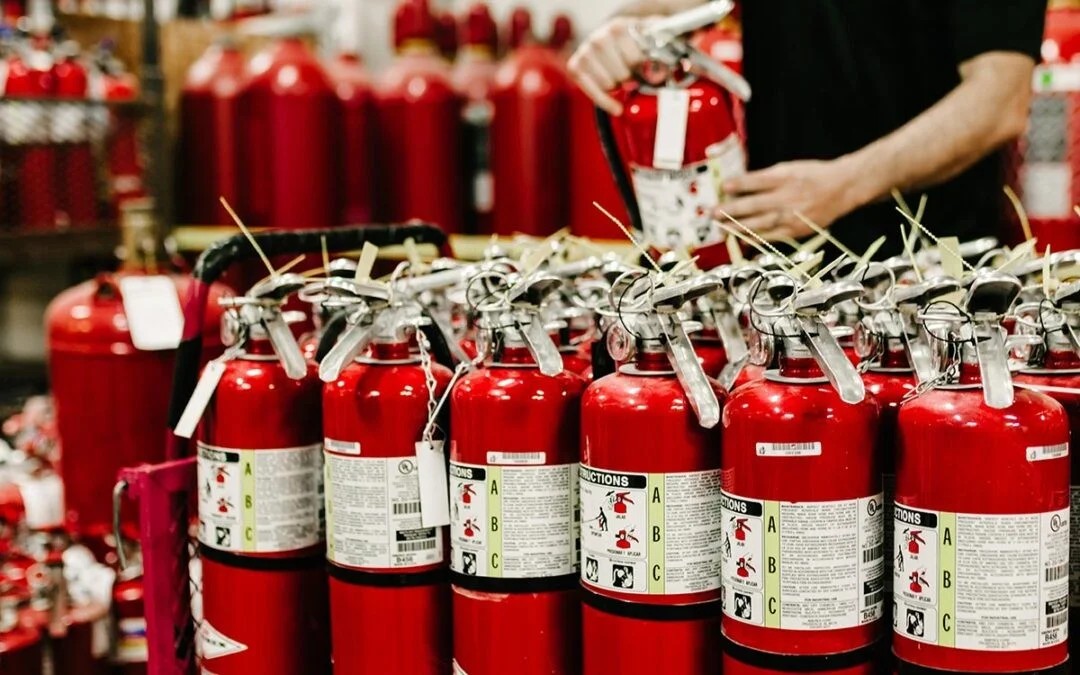
If you just failed a fire inspection at your Orange County property, the first thing to know is this: you have time to fix it, but the clock has already started. The Orange County Fire Authority (OCFA) and city fire departments across OC issue Notices of Violation that list every deficiency they found, along with a correction deadline. Missing that deadline triggers reinspection fees, additional violations, and in serious cases civil penalties or business shutdown.
Spectrum has been helping property owners with fire protection in Orange County since 1987. This guide walks through exactly what happens after a failed inspection, what your real options are, how much it costs, and how to make sure you pass the reinspection.
The quick answer: After a failed fire inspection in Orange County, the inspector issues a written Notice of Violation listing the deficiencies. You typically have 15 to 90 days to correct them, depending on severity. OCFA charges a base inspection fee (M150) plus a reinspection fee (J200) for additional site visits. Repeat failures trigger civil penalties starting around $500 per violation and can reach $5,000 or more for serious life-safety issues. In extreme cases, the fire department can shut down your business until compliance is achieved.
Why your building is being inspected in the first place
Every commercial building in California is subject to annual fire and life safety inspections under the California Fire Code and Title 19. In Orange County, those inspections are conducted by OCFA in most cities, and by city fire departments in Anaheim, Fullerton, Garden Grove, Huntington Beach, Newport Beach, Orange, and a few others that operate their own fire services.
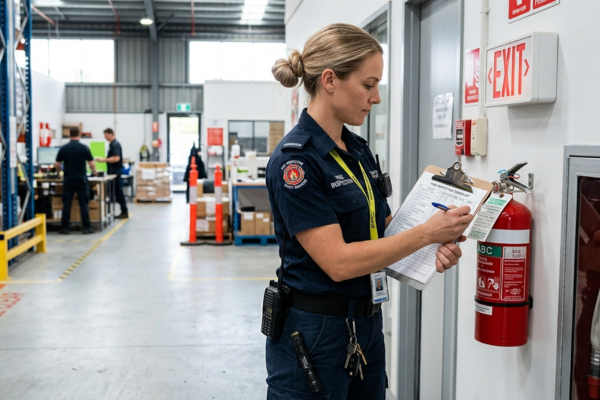
The inspector's job is to confirm your building's fire protection systems are in compliance with NFPA standards and local fire code. As an Orange County fire protection contractor serving OC since 1987, we know exactly what they look at: the working condition of your sprinkler system, fire alarm, fire extinguishers, emergency lighting, exit signage, kitchen hood suppression (if applicable), fire pumps, hydrants, and any specialty suppression systems.
If they find anything that doesn't meet code, expired extinguisher tags, a blocked sprinkler head, a non-functional emergency light, an outdated kitchen hood inspection that becomes a documented violation.
Step 1: The Notice of Violation
When you fail an inspection, the inspector hands you (or mails you) a written Notice of Violation. It lists three things:
- Every violation found described by code section and physical location in the building
- The correction deadline typically 15 business days for routine violations, but as little as 24 hours for serious life-safety hazards
- Inspector contact information so you can schedule the reinspection once corrections are made
The Notice is a legal document. Once you receive it, you have an obligation to correct the deficiencies within the stated timeframe. You also have the right to request a reasonable extension if the corrections require ordering parts, scheduling specialty contractors, or coordinating with tenants.
Common violations we see across OC commercial properties
In our 39 years providing commercial fire protection services in OC, these are the violations that show up most often:
- Expired or missing fire extinguisher tags extinguishers must be inspected annually under NFPA 10. Spectrum's fire extinguisher service catches these before the marshal does.
- Blocked sprinkler heads or storage within 18 inches of sprinklers is a common warehouse and stockroom violation. NFPA 25 governs the maintenance side. See Spectrum's fire sprinkler service page for full inspection details.
- Non-functional emergency lights or exit signs Cal/OSHA Title 8 CCR §3216 and NFPA 101 require monthly functional testing and annual 90-minute battery testing. Spectrum's exit sign and emergency light service handles both.
- Kitchen hood suppression past its 6-month inspection NFPA 96 requires semi-annual servicing of every commercial kitchen hood system. Spectrum's kitchen hood suppression service is the most common single fix we make for OC restaurants after a failed inspection.
- Outdated fire alarm monitoring or untested alarm devices NFPA 72 governs monthly visual checks, annual full testing, and signal verification with the monitoring station. See Spectrum's fire alarm service.
- Fire pumps without weekly churn test logs or annual flow tests required under NFPA 25. Spectrum's fire pump testing service provides AHJ-acceptable documentation.
- Private hydrants without the required NFPA 25 annual inspection or NFPA 291 5-year flow test. Spectrum's fire hydrant service handles both.
Step 2: The cost what failing an inspection actually costs you
This is the part most property owners don't fully understand until they're paying it. OCFA's fee structure has two components that show up after a failed inspection:
- Base inspection fee (M150). Charged for the original annual inspection. This applies whether you pass or fail.
- Reinspection fee (J200). Charged for each additional site visit beyond the standard two. If you fail the first inspection, the second visit is typically covered. If you fail that second visit, every additional reinspection triggers a new J200 fee.
On top of those, civil penalties apply when violations remain uncorrected after the correction deadline. Penalty amounts vary by city and severity but typically start around $500 per violation for routine deficiencies and can reach $5,000 or more for serious life-safety hazards under California Fire Code enforcement. Repeat offenders face escalating penalties under municipal codes.
And those are just the direct costs. The indirect costs are often larger:
- Insurance premium increases many commercial property insurers require copies of passing fire inspection reports. A failure on file can raise your premiums or trigger a coverage review.
- Operational shutdown for serious violations, the fire department has the authority to issue a stop-work order or close occupancy until corrections are made. For restaurants, that means closed doors. For warehouses, that means halted operations.
- Liability exposure: if a fire occurs at your property between a failed inspection and the correction, and the cause overlaps with a documented violation, your liability picture changes dramatically.
- Lease consequences most commercial leases require tenants to maintain fire code compliance. A documented violation can trigger landlord-tenant disputes or default notices.
Step 3: The correction timeline what you actually need to do
The exact correction timeline depends on the violation type, but the general framework across OC fire authorities is consistent:
Immediate (24 hours) serious life-safety violations
Blocked exits, non-working fire alarm in an occupied building, completely failed sprinkler system, unauthorized hazardous material storage these get an immediate correction order. The inspector may require corrections before they leave the property, or within 24 hours. In extreme cases, occupancy is suspended until the issue is resolved.
Short-term (15 business days) routine violations
Expired extinguisher tags, missing inspection documentation, minor signage issues, a few non-working emergency lights these typically get 15 business days to correct. Beverly Hills, Folsom, and most OC city fire departments use this 15-day standard.
Extended (30-90 days) system-level violations
Failed sprinkler inspection, fire pump that didn't pass its annual flow test, kitchen hood suppression system needing recharge or component replacement, fire alarm system requiring panel replacement these often need 30 to 90 days because they involve ordering parts, scheduling specialty contractors, and coordinating shutdowns.
Step 4: Fixing the violations and passing reinspection
Once you have your Notice of Violation in hand, the process is straightforward but has to be done correctly:
- 1. Read every item carefully. Each violation is tied to a specific code section. Make sure you understand exactly what's required to come into compliance not just what the inspector flagged, but the underlying code requirement.
- 2. Get a licensed fire protection contractor on-site within 48 hours. Most violations require work by a California C-16 licensed fire protection contractor. Spectrum holds C-16 #886810 and can usually be on-site within 24-48 hours for OC properties.
- 3. Get documentation for every correction. Every repair, replacement, or service action needs a written record. Service tags on extinguishers, inspection reports for sprinklers and pumps, alarm test certificates, kitchen hood service stickers. Without documentation, the inspector can't verify the correction even if the work was done.
- 4. Schedule the reinspection before the deadline expires. Don't wait until the last day. Contact the inspector once corrections are complete and request the reinspection. Most OC fire authorities can schedule within a few business days.
- 5. Keep all corrected-violation paperwork in a single file. Your insurance carrier may want it. Your landlord may want it. Future inspections will reference past violations having documented corrections protects you in every subsequent inspection cycle.
How to avoid failing the next inspection
After 39 years of inspections across Orange County restaurants in Anaheim, warehouses in Santa Ana, data centers in Irvine, hotels in Newport Beach, apartment complexes in Garden Grove the buildings that consistently pass are the ones that don't treat the annual inspection as a single event. They treat fire protection as an ongoing program.
Here's what that looks like in practice:
- Quarterly self-checks. Walk your property quarterly with a written checklist. Look for blocked sprinklers, missing extinguisher tags, burned-out exit signs, fire doors propped open. Most violations are caught early when someone is looking.
- Service contracts on every required system. Sprinklers, extinguishers, alarms, kitchen hoods, fire pumps, hydrants each one has a required inspection cadence under NFPA standards. A service contract means it happens automatically, with documentation, on schedule.
- A pre-inspection walk-through 30 days before the AHJ visit. Spectrum offers pre-inspection walk-throughs across OC. We inspect the property the way OCFA or your city fire department will, identify anything that would fail, and fix it before the official inspection happens. It's almost always cheaper than failing the real inspection and paying reinspection fees.
- Centralized documentation. Every test, every service, every replacement all in one binder or one digital file. When the inspector asks for documentation, you have it immediately. Missing paperwork is one of the most common violation types we see, and it's the easiest to prevent.
When to call a fire protection contractor
Three moments where calling Spectrum (or any licensed C-16 contractor) makes the most difference:
- Before your annual inspection. A pre-inspection walk-through identifies issues while you still have time to fix them on your schedule, not the inspector's.
- Immediately after a failure. Speed matters. The faster corrections are made and documented, the sooner the reinspection happens and the less risk of escalating penalties.
- When you take over a new property. If you've just bought, leased, or assumed management of a commercial building, get a fire protection assessment in the first 30 days. You don't want to inherit someone else's violations and discover them during your first inspection.
How Spectrum helps OC property owners pass inspection
As the Orange County fire protection company has passed inspections for OC restaurants, hotels, warehouses, schools, hospitals, data centers, and commercial properties since 1987, Spectrum knows exactly what every OC fire authority looks for. We hold California C-16 #886810 and State Fire Marshal E-2293, and we're authorized partners with Amerex, Stat-X, and Hochiki covering every required system in one contractor relationship.
If you just failed an inspection, we can usually be on-site within 24-48 hours anywhere in Orange County, document the corrections to AHJ standards, and have you ready for reinspection before your correction deadline expires.
Just failed an inspection? Or want to make sure you don't?
Call Spectrum at (714) 213-8451 or request a pre-inspection assessment through our contact page. Our team covers Anaheim, Garden Grove, Santa Ana, Irvine, Huntington Beach, Fullerton, Newport Beach, and the wider Orange County region. Whether you're recovering from a failed inspection or preparing for an upcoming one, we can help the same week if needed.


.png)

.png)

.png)


.png)