

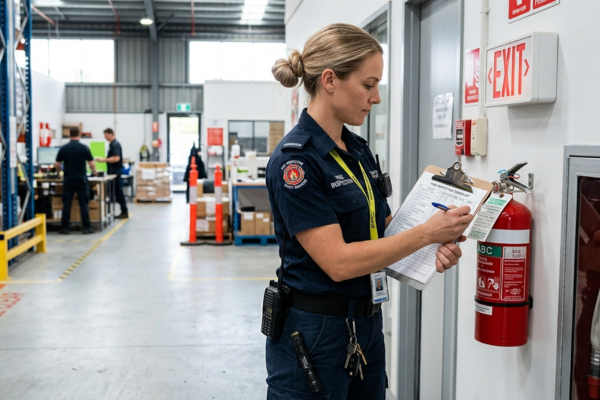
The fire marshal will inspect your commercial property whether or not you are ready. Most properties that fail their fire inspections fail because of issues the property manager could have caught and fixed months earlier with a simple monthly walk-through.
This guide is the checklist we use ourselves when Spectrum Fire Protection performs pre-inspection walk-throughs for property managers across Orange County. It covers every item that needs to be checked on a commercial property, how often each item should be checked, who can legally perform each inspection, and what to do when you find something that does not pass.
Read this guide in full, build a recurring monthly inspection routine around the checklist below, and your property will never fail a fire marshal inspection again. The checklist is broken into three parts: monthly items you can do yourself, quarterly items that may require a contractor, and annual items that always require a licensed professional.
Why Self-Inspection Matters More Than You Think
Most commercial property owners think of fire inspection as something the fire marshal does once a year. The reality is that California Fire Code requires ongoing inspection at multiple frequencies, and the fire marshal's annual visit is only the verification step at the end of that process.
Property managers who treat self-inspection as a monthly routine instead of an annual scramble see three concrete benefits:
- Lower repair costs. Catching a problem early (a cracked exit sign, a low extinguisher gauge, a blocked egress path) costs almost nothing to fix. Letting that same problem accumulate until the fire marshal cites it can cost hundreds in fines plus the original repair cost.
- Faster fire marshal visits. When everything passes on the first walk-through, the fire marshal is in and out in 30 to 60 minutes. When deficiencies are found, the inspection takes longer, documentation requirements multiply, and re-inspection fees apply.
- Insurance protection. Most commercial property insurance policies require fire protection systems to be inspected and maintained per applicable codes. If a fire causes damage and you cannot produce inspection records, the carrier can reduce or deny the claim entirely.
If you would rather have a professional handle the inspection schedule for you, Spectrum Fire Protection offers recurring inspection programs for Orange County properties that include everything in this checklist plus the licensed contractor items.
What You Can Inspect Yourself vs What Requires a Contractor
Before you start using the checklists below, it is important to understand which inspection items property staff can perform themselves and which items must be performed by a licensed contractor. California fire code is clear about this distinction, and doing the wrong items yourself can void your compliance documentation.
Items Property Staff Can Perform
Property managers and trained maintenance staff can legally perform the visual inspection items in the monthly and some quarterly categories. These are visual checks that do not require specialized equipment or licensing. Examples include verifying that fire extinguishers are in their proper location with intact seals, checking that exit signs are illuminated, and ensuring that sprinkler control valves are in the correct position.
Items That Require a Licensed Contractor
Tests that involve actually triggering alarm devices, running fire pumps, pressure-testing components, or recharging extinguishers require a contractor holding the appropriate California state licenses. Specifically, California Contractors State License Board C-16 (Fire Protection) and C-10 (Electrical) licenses are required for the majority of these tests. California State Fire Marshal licenses E and A are also required for certain extinguisher and suppression work.
Here is the master frequency table covering every commercial fire inspection item, when it must be done, and who can perform it:
Monthly Self-Inspection Checklist
These are the items property managers should check every month. The entire monthly walk-through takes 30 to 60 minutes for a typical commercial property and prevents the vast majority of fire marshal citations.
Use the checkboxes below to track your progress. Print this section, walk the property with it, and check each item as you verify it.
1. Fire Extinguishers
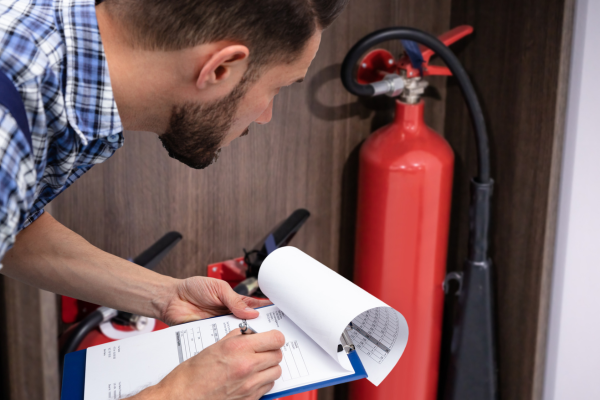
Walk to every fire extinguisher in the building. For each one, verify:
☐ The pressure gauge needle is in the green zone (not red, not yellow)
☐ The pin and tamper seal are both intact and present
☐ The inspection tag shows the most recent annual service date and is not expired
☐ The extinguisher is mounted in its proper bracket or wall hanger
☐ There is no visible damage, dents, corrosion, or missing parts
☐ The discharge hose and nozzle are in good condition with no cracks or breaks
☐ The operating instructions label is legible and facing outward
☐ The extinguisher is not blocked, covered, or obstructed from view
☐ Signage above the extinguisher is visible from across the room
If any extinguisher fails any of these checks, schedule fire extinguisher service to recharge, replace, or repair the unit before the next monthly check. Damaged extinguishers must be replaced immediately, not next month.
2. Exit Signs and Emergency Lighting
Every exit sign and emergency light in the building needs a monthly visual check.
☐ Every exit sign is illuminated (both halves of the bulb pair, if applicable)
☐ Exit sign lettering is fully visible with no missing letters or cracked lenses
☐ Emergency lights are visible and properly mounted
☐ Emergency light bulbs are intact (no broken or missing fixtures)
☐ The test button on each emergency light unit works (press and hold for 30 seconds)
☐ During the 30-second test, lights stay on at full brightness with no flickering
☐ Battery indicator lights show normal (usually a small green LED)
Failed emergency lights usually mean a dead battery, which is a simple replacement. Spectrum Fire Protection services exit signs and emergency lighting if you find more than one or two failures and want a complete sweep.
3. Fire Sprinkler System (Visual)
You cannot test the sprinkler system yourself, but you can verify it is in the correct state during a monthly walk-through.
☐ All control valves are in the FULL OPEN position
☐ Valve tamper seals or chains are intact and not broken
☐ Pressure gauges on the riser show normal readings
☐ The riser room or sprinkler control area is clear and accessible
☐ No storage is within 18 inches of any sprinkler head
☐ No sprinkler heads have been painted, covered, or damaged
☐ Sprinkler heads in dust-prone areas are not covered in lint or debris
☐ The spare sprinkler cabinet contains the required spare heads and proper sprinkler wrench
☐ Hydraulic design nameplate on the riser is legible and not painted over
4. Fire Alarm Panel
Walk to the fire alarm control panel and verify:
☐ Power indicator light shows GREEN or NORMAL
☐ No yellow TROUBLE light is illuminated
☐ No red ALARM light is illuminated
☐ Display screen shows NORMAL or SYSTEM NORMAL
☐ No audible trouble buzzer is sounding
☐ Panel door is locked and key is in the proper location
Any trouble or alarm condition that you cannot identify and clear yourself needs to be addressed by a licensed alarm technician. Our fire alarm service team responds 24/7 across Orange County for trouble conditions and alarm failures.
5. Means of Egress (Exits and Exit Pathways)
Means of egress violations are one of the most commonly cited deficiencies during fire marshal inspections. Walk every exit pathway and verify:
☐ Every exit door opens easily from inside with one motion (no special knowledge or key required)
☐ No exit door is chained, padlocked, or otherwise secured against egress
☐ Exit pathways are clear with no stored materials, furniture, or equipment blocking the path
☐ Minimum 44-inch clear width is maintained in exit corridors (verify with a measuring tape)
☐ Exit signage is visible from any point along the egress path
☐ No items are stored under stairwells (this is a common violation)
☐ Stairwell doors close completely and latch when released
☐ Panic hardware (push bars) on exits operates properly with one push
☐ No doors are propped open with wedges, chairs, or other improvised devices
6. Fire Doors
Fire-rated doors separate fire compartments and slow fire spread. They need to function properly to maintain their rating.
☐ Every fire door closes completely from any open position
☐ Latches engage automatically when the door closes
☐ No gaps larger than the manufacturer's specification exist at the top, sides, or bottom
☐ Door coordinators on double doors are functioning (doors close in the proper sequence)
☐ Fire door labels are visible on the edge of each door
☐ No holes, modifications, or damage compromise the door's fire rating
☐ Door closers are not removed, painted over, or rendered inoperable
7. Storage and Housekeeping
Improper storage is the leading cause of fire spread and one of the most common citations during commercial inspections.
☐ All storage is at least 18 inches below sprinkler heads (24 inches in spaces without sprinklers)
☐ No combustible storage is in electrical rooms or near electrical panels
☐ Electrical panels have at least 36 inches of clearance in front of them
☐ Flammable liquids are stored in approved cabinets, not on open shelves
☐ Compressed gas cylinders are chained or secured upright (not lying flat)
☐ Trash and recycling bins are not overflowing or accumulating combustibles
☐ No extension cords are used as permanent wiring
☐ No frayed, damaged, or improperly used electrical cords are visible
☐ No items are stored in mechanical rooms beyond their intended use
8. Knox Box and Fire Department Access
Most commercial properties have a Knox box (a small lockbox containing master keys for fire department use). Verify:
☐ The Knox box is mounted in its proper location (usually near the main entrance)
☐ The Knox box is unobstructed and visible from the fire lane
☐ No paint or signage covers the Knox box
☐ Fire lanes are unobstructed (no parked vehicles, no stored materials)
☐ Fire lane markings on pavement are legible
☐ Building address numbers are visible from the street, both day and night
☐ Address numbers are at least 6 inches tall in contrasting color
9. Fire Department Connection (FDC) and Hydrants
If your property has a fire department connection (the inlets where fire trucks connect to pressurize your sprinkler system) or private fire hydrants, check them monthly.
☐ All FDC caps are in place and not damaged
☐ FDC threads are clean and undamaged (check by removing a cap briefly)
☐ FDC is accessible from the street with no parked cars or obstructions
☐ Identification sign on the FDC is legible (showing what it serves)
☐ Private hydrants are clearly marked and visible
☐ No vegetation, signage, or vehicles block hydrant access
☐ Hydrant markers (blue reflectors on pavement) are intact if installed
Quarterly Inspection Items
Quarterly inspection items add another layer to the routine. Some of these can be done by trained property staff, but most should be performed by a licensed fire protection contractor because they involve actually testing system components, not just visually inspecting them.
Sprinkler Alarm Device Testing
Every quarter, the alarm devices on your sprinkler system need to be tested to confirm they will activate and transmit a signal when water flows. This includes water flow switches, pressure switches, and supervisory signal devices. The test involves opening the alarm test connection to flow water through the switch, confirming the local alarm sounds, and verifying the monitoring company received the signal. This must be performed by a licensed contractor. Learn more about Spectrum's sprinkler inspection services.
Hydraulic Nameplate Inspection
The hydraulic design nameplate on every sprinkler riser needs quarterly inspection to verify it remains legible and accessible. If it is damaged, painted over, or missing, it must be replaced with a new nameplate showing the original design parameters.
Fire Department Connection Component Inspection
Beyond the monthly visual check, quarterly FDC inspection verifies internal components: check valve operation, threading condition, internal corrosion, and overall structural integrity. This typically requires removing caps and inspecting internal components, which is best done by a contractor.
Quarterly Documentation Requirements
Quarterly inspection reports should include the same baseline information as monthly inspections plus specific test results: which switches were tested, what activation pressure was observed, whether the monitoring center confirmed signal receipt, and what the response time was.
Annual Inspection Items (Licensed Contractor Required)
Annual inspections are the items that absolutely require a licensed fire protection contractor. These are not items property staff can legally perform. Skipping them or attempting to perform them yourself voids your compliance documentation.
Annual Fire Extinguisher Inspection and Recertification
California law requires every commercial fire extinguisher to be inspected and recertified annually by a State Fire Marshal licensed company. During this inspection, the contractor will check the pressure gauge, verify seal and pin integrity, weigh the cylinder to confirm proper charge, inspect the hose and nozzle, internally examine the unit, and replace the inspection tag with one showing the next service date. Our fire extinguisher services cover all extinguisher types and provide tags accepted by every Orange County jurisdiction.
Annual Fire Alarm System Testing
Annual fire alarm testing per NFPA 72 requires testing every smoke detector and pull station in the building, checking the control panel, verifying that horns and strobes operate, testing backup batteries under load, and confirming the monitoring center receives signals from each device. This is a multi-hour inspection for most commercial properties. See our fire alarm inspection service for full details.
Annual Sprinkler System Inspection (NFPA 25)
The annual sprinkler system inspection is the most comprehensive of all the recurring inspections. It covers every visible sprinkler head, pipe hangers, antifreeze concentrations, system signage, spare sprinkler cabinets, and backflow preventers. We covered the full NFPA 25 testing requirements in our complete NFPA 25 testing requirements guide.
Annual Emergency Lighting 90-Minute Load Test
Beyond the monthly 30-second test, emergency lighting needs a full 90-minute load test annually to confirm the batteries will actually power the lights for the full required duration during a real power outage. Lights that pass the 30-second test can still fail the 90-minute test if their batteries are aging.
Annual Fire Pump Flow Test
If your property has a fire pump, the annual flow test runs the pump at full design capacity to verify it can deliver the rated flow at the rated pressure. The test produces a performance graph compared against the original acceptance test. See our fire pump testing service for the full procedure.
Annual Backflow Preventer Testing
Backflow preventers on the sprinkler system require annual testing by a certified tester. The report is submitted directly to the water authority. Failure to test backflow preventers can result in water service shutoff in some jurisdictions.
Semi-Annual Items (Kitchen Suppression and Special Systems)
Kitchen Hood Fire Suppression Service
California requires kitchen hood suppression systems to be serviced every 6 months. During the service, the contractor inspects every nozzle, tests the fusible links, verifies chemical levels, confirms the manual pull and automatic detection both function, and replaces expired components. Spectrum Fire Protection's kitchen hood suppression service is required for any restaurant or commercial kitchen with a Type I hood.
Spray Booth Fire Suppression
Paint spray booth suppression systems require semi-annual inspection to verify nozzles, chemical levels, and detection systems are operational. This is required for automotive paint operations, industrial finishing, and similar facilities.
5-Year and Longer Inspection Items
Some compliance items come around less frequently but are equally important. Missing these long-cycle items is one of the most expensive mistakes property owners make because the work involved is much more extensive than annual inspections.
5-Year Sprinkler System Certification (California Title 19)
California requires a deep certification of all water-based fire protection systems every 5 years under California Title 19. This involves draining the system, internally inspecting the piping, hydrostatically testing components, replacing gauges, and issuing a state certification. Spectrum Fire Protection handles 5-year certifications across Orange County.
12-Year Fire Extinguisher Hydrostatic Test
Every fire extinguisher needs hydrostatic pressure testing every 12 years (or every 5 years for CO2 and water-type units). The cylinder is pressure-tested to verify it can safely hold its rated pressure. Extinguishers that pass are recharged and recertified for another cycle. Extinguishers that fail are scrapped and replaced.
10-Year Sprinkler Head Sample Testing
Certain sprinkler heads (notably dry sprinklers and sprinklers in harsh environments) need sample testing every 10 years. A representative sample is removed, sent to a testing laboratory, and verified for proper activation temperature and response time.
Documentation You Must Keep
All the inspections in the world will not protect you if you cannot prove they happened. California fire code requires inspection records to be maintained on the premises and made available for review when requested by the fire marshal.
Records You Must Keep On Site
- Monthly self-inspection logs for at least the past 12 months
- Quarterly inspection reports from your contractor
- Annual inspection reports for at least the past 3 years
- 5-year certification documentation (current cycle)
- Original system acceptance test documentation (kept for the life of the system)
- Hydraulic calculations and design drawings
- Records of all deficiencies found and the corrective action taken
- Monitoring company contract and contact information
- Contractor contact information for emergency response
Common Deficiencies Cited in Orange County Inspections
Based on the pre-inspection walk-throughs Spectrum Fire Protection performs for property managers across Orange County, here are the most frequent deficiencies we identify before the fire marshal arrives. If you know these in advance, you can check for them specifically during your monthly walk-throughs:
1. Painted Sprinkler Heads
Painters touch up walls and accidentally coat the sprinkler heads. Painted sprinklers cannot reliably activate because the paint can prevent the fusible link or glass bulb from breaking at the correct temperature. Any painted sprinkler must be immediately replaced, not cleaned.
2. Blocked Sprinkler Heads
Storage stacked too close to sprinkler heads (less than 18 inches below) prevents the sprinkler from distributing water properly during a fire. This is one of the most common citations in warehouses and retail spaces.
3. Locked or Chained Exit Doors
During business hours, every exit door must be operable from inside with one motion. Chains, padlocks, or any other security measure that prevents exit during operating hours is a serious violation that can result in immediate closure orders.
4. Missing or Expired Extinguisher Tags
Fire extinguishers must have a current annual inspection tag showing the most recent service date. Missing tags, expired tags, or tags showing an inspection over a year ago all result in citations and require service before the property passes.
5. Inoperative Exit Signs
Burned-out bulbs, broken lenses, or signs that fail the test button are commonly missed during monthly checks. Property staff often assume the sign works because it looks normal at a glance without actually testing it.
6. Obstructed Fire Lanes
Parked vehicles, construction materials, or stored equipment blocking fire lanes prevent fire department access. Even temporary obstructions can result in citations if observed during an inspection.
7. Closed or Tampered Control Valves
Control valves on sprinkler systems must be in the proper position with tamper seals intact. Valves accidentally closed during maintenance and not reopened are catastrophic failures waiting to happen. Tamper seals broken without authorization indicate a chain-of-custody problem with system maintenance.
8. Improperly Stored Materials in Electrical Rooms
Electrical panels require 36 inches of clearance in front of them. Storing materials in electrical rooms (a common shortcut in many properties) creates both fire and electrical hazards and violates both fire code and electrical code.
Penalties for Failed Inspections
The financial impact of failed inspections runs much higher than the cost of compliance. Here is what property owners actually face when fire marshals find significant deficiencies:
Direct Fines
Local fire marshals can issue citations with fines that vary by jurisdiction. Typical first-offense fines range from a few hundred to several thousand dollars per violation. Each separate deficiency can be cited individually, so a building with five issues can face five separate fines.
Re-Inspection Fees
When the fire marshal returns to verify corrections, you typically pay a re-inspection fee. Properties that fail multiple consecutive inspections accumulate substantial re-inspection costs that often exceed the cost of doing the original work correctly.
Loss of Occupancy
In serious cases (locked exits during business hours, completely disabled sprinkler systems, multiple major violations), the fire marshal can suspend occupancy of the building until compliance is restored. For an operating business, this means immediate closure. For a multi-tenant property, it can mean evacuating tenants.
Insurance Implications
Commercial property insurance policies generally require fire protection systems to be inspected and maintained per applicable codes. If you cannot produce inspection records after a fire event, the carrier can reduce or deny the claim. We have seen claims denied for hundreds of thousands of dollars over missing routine inspection paperwork.
Personal Liability
In situations where a fire causes injury or death and inspection records are missing, the responsible party (often the property manager or business owner who signed the certificate of occupancy) can face civil liability and in extreme cases criminal negligence charges.
When to Stop Self-Inspecting and Call a Professional
Self-inspection is valuable, but it has clear limits. Call a professional immediately if any of the following occur during your monthly walk-through:
- Any fire alarm trouble or alarm light you cannot identify and clear yourself
- Any active leak from a sprinkler head, pipe, or valve
- A sprinkler control valve found in the closed position when it should be open
- A fire extinguisher with the pressure gauge in the red zone
- Any sign of physical damage to a sprinkler head (compressed, missing, painted, or broken)
- Any exit door that does not open easily or any door hardware that does not function
- Any fire-rated door that does not close completely or fails to latch
- Smoke detectors showing trouble status or constantly false-alarming
- Any sign of corrosion, rust, or water damage on fire protection components
- Anything you are unsure about
For Orange County properties, Spectrum responds 24/7 to fire protection emergencies and same-day for non-emergency repairs. Calling early prevents small issues from becoming citation-worthy deficiencies.
Frequently Asked Questions
How often does my commercial property get inspected by the fire marshal?
Most commercial properties in Orange County receive an annual fire marshal inspection. Higher-risk properties (restaurants, healthcare facilities, large assemblies) may be inspected more frequently. New properties typically receive an initial inspection at occupancy and then annual inspections after that. High-risk industrial facilities may have separate inspection schedules from specific authorities.
Do I have to be present during the fire marshal inspection?
The property manager or owner's representative should be present during the inspection. The inspector will need access to mechanical rooms, electrical rooms, and other restricted areas. Having someone present also allows you to address any questions immediately and request clarification on any cited deficiencies.
What happens if I fail a fire marshal inspection?
You will receive a written report listing the deficiencies and a deadline for correction (typically 30 to 60 days, sometimes less for serious issues). After correcting the deficiencies, the fire marshal returns to re-inspect. Re-inspection fees usually apply. If you do not correct deficiencies by the deadline, additional citations and potential loss of occupancy can result.
Can I appeal a fire marshal citation?
Yes, most jurisdictions have an appeal process. Contact your local fire department or fire marshal's office for the specific appeal procedure in your area. Appeals are typically filed within a specific window after the citation date. In Orange County, OCFA handles appeals for properties in their jurisdiction; individual cities handle appeals for properties served by city fire departments.
Who is responsible for fire inspections in a leased commercial space: the landlord or the tenant?
This depends on your lease agreement. Generally, the property owner is ultimately responsible for life safety system compliance, but many commercial leases (especially triple net leases) pass operational responsibility to the tenant. Check your specific lease for fire protection and maintenance clauses. Both parties have an interest in compliance because both face liability exposure.
Are home-based businesses subject to commercial fire inspections?
Generally no, home-based businesses operating from a residence are subject to residential fire codes rather than commercial inspection requirements. However, if your home-based business stores significant quantities of inventory, hazardous materials, or has employees on site, additional requirements may apply. Check with your local fire department for specific guidance.
How much does ongoing fire inspection compliance cost?
Costs vary based on property size, system complexity, and which services you need. As a general guide, a typical small commercial property (under 25,000 square feet) might spend a few hundred to a couple thousand dollars annually on all required inspections and basic maintenance. Larger properties, properties with fire pumps, and properties with kitchen suppression systems will spend more. Self-performed monthly inspections add zero direct cost (labor time only).
Working with Spectrum on Your Fire Inspection Program
Spectrum Fire Protection has been managing fire inspection compliance for Orange County commercial properties since 1987. We hold every California license required to perform every inspection on the contractor portion of this checklist: CSLB C-16 Fire Protection Contractor License #886810, CSLB C-10 Electrical Contractor License, California State Fire Marshal licenses E-2293 and A-0448, and OCFA approval. Founder Sam K. serves on the committee that helps shape California's C-16 contractor licensing exam. Read more about our credentials and certifications, or learn about Sam K. and Spectrum's history.
When property managers partner with Spectrum for their fire inspection program, they get:
- All required contractor inspections scheduled and tracked automatically
- Documentation organized in a binder or digital folder ready for fire marshal review
- Direct coordination with OCFA and local fire departments on permits and corrections
- Repair and remediation work handled by the same team that performed the inspection
- 24/7 emergency response between scheduled inspection visits
- Training and templates for your in-house staff doing monthly walk-throughs
If you want to put your property on a reliable fire inspection program, contact Spectrum's team for a free consultation or call (714) 213-8451. We service properties across all 34 Orange County cities, plus Los Angeles, Riverside, and San Bernardino counties.


.png)

.png)

.png)


.png)