

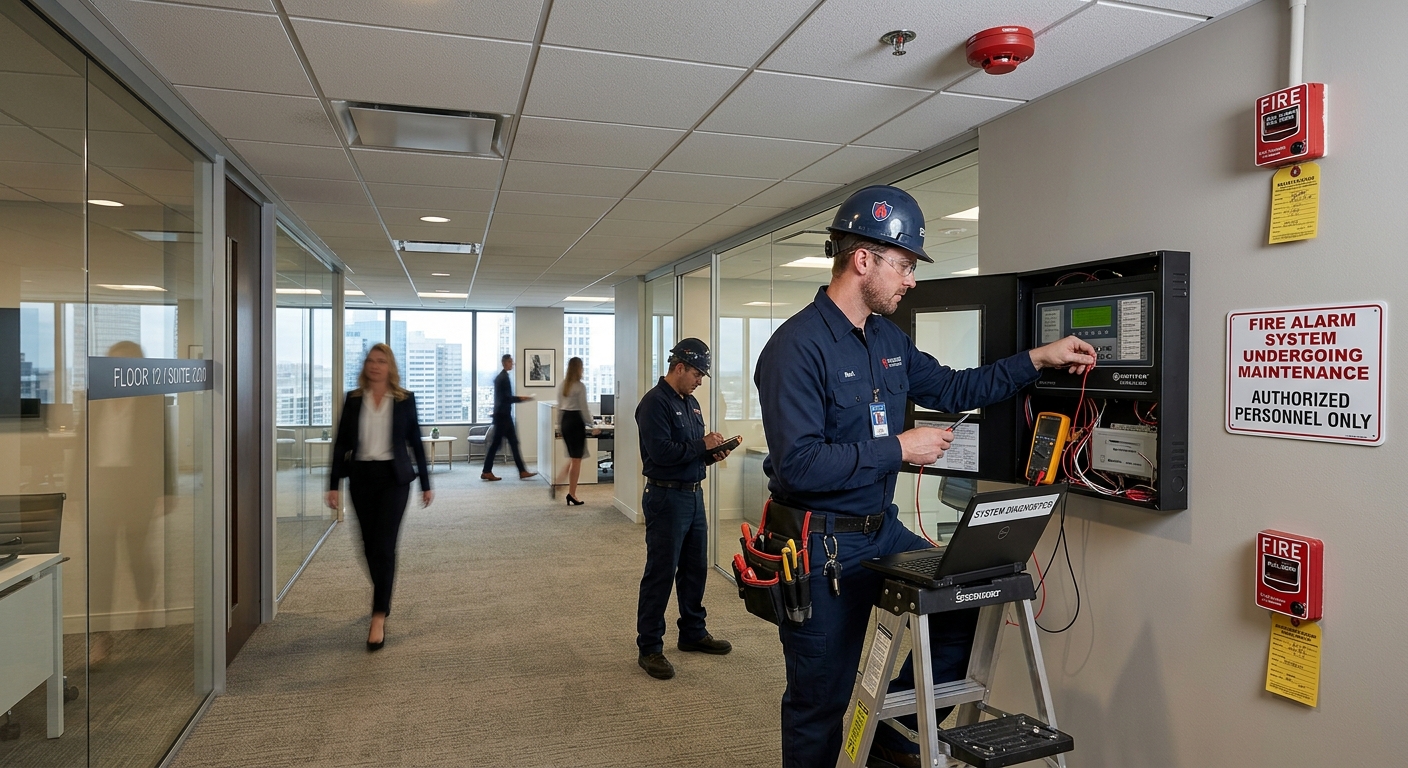
Quick answer: Title 19 of the California Code of Regulations, the State Fire Marshal's regulations, doesn't set technical monitoring specs like signal transmission time. Those come from NFPA 72, adopted and amended through Title 24. What Title 19 actually requires is that fire alarm and monitoring connections stay operable at all times, that a fire watch begin immediately if a required system goes out of service, that inspection records stay on-site for five years, and that anyone inspecting a system for a fee hold a State Fire Marshal license or a C-16 contractor license. On top of that, a separate California requirement, BSIS Alarm Company licensing, governs who can legally sell, install, or monitor the alarm connection itself.
That's a lot packed into one regulation title. Here's what each piece means, and why the common shorthand of "Title 19 requires monitored fire alarms" isn't quite the full picture.
What Title 19 Actually Is
Title 19 is Division 1 of the California Code of Regulations, officially called the Regulations of the State Fire Marshal. It's a real, specific body of law, but it isn't the document that tells a fire alarm system how fast a signal has to reach a monitoring center or how many hours of battery backup it needs. Those technical requirements come from NFPA 72, the National Fire Alarm and Signaling Code, which California adopts and amends through Title 24, the California Building Standards Code.
Title 19's job is different. It's the layer that governs what happens after a system is installed: keeping it working, proving it's being tested, and controlling who's legally allowed to touch it. For fire alarm monitoring specifically, that distinction matters more than it sounds like it should, because it changes what you're actually supposed to ask a contractor or a fire marshal when you're trying to confirm compliance.
The Common Misconception, and Why It Matters
Search for "Title 19 fire alarm monitoring" and you'll find a lot of content that treats Title 19 as if it's the source of requirements like 24/7 monitoring or a specific dispatch time. It isn't, not directly. Those requirements exist because of NFPA 72 and the California Fire Code, and Title 19 sits alongside them rather than being the source of them.
This isn't just a technical distinction for its own sake. If you call a fire marshal's office and ask about "Title 19 monitoring requirements," you may get redirected to the fire code discussion, because the specific number you're often actually asking about, how fast a signal has to reach help, lives in NFPA 72's Chapter 26, not in Title 19. Title 19 is where the maintenance mandate, the recordkeeping rule, and the licensing requirement live instead, on top of whatever monitoring service and technical setup NFPA 72 already requires. Knowing which question belongs to which code makes the conversation with your fire authority a lot shorter.
The "Operable at All Times" Standard
Title 19, Division 1, Sections 1.14 and 3.24 set the baseline that everything else builds on: every fire alarm system, sprinkler system, extinguisher, and other required fire safety equipment has to be maintained in an operable condition at all times. Not "when it's convenient to schedule service." At all times.
The regulation goes further: if the fire-protective qualities of a system are disrupted or diminished in any way, immediate action has to be taken to restore it to normal operating condition. That single standard is why a fire alarm system with a lapsed monitoring connection isn't a minor administrative issue under California law. It's a direct violation of an ongoing legal obligation, not a one-time installation requirement you satisfy and move on from.
What Happens When a System Goes Out of Service: The Fire Watch Rule
This is one of the more consequential pieces of Title 19, and one of the least understood. Under Section 904.1(c), if a required fire protection system goes out of service, including a fire alarm monitoring connection, the fire department and the fire code official have to be notified immediately. Depending on what the fire code official determines, the building either has to be evacuated or an approved fire watch has to be put in place for every occupant left unprotected by the shutdown, and that fire watch stays in effect until the system is back in service.
A fire watch isn't free, and it isn't simple. It usually means paying trained personnel to patrol the building continuously with a way to notify the fire department, for as long as the outage lasts. This is the real cost of an unmonitored gap that most property owners don't think about until they're the ones arranging it. Keeping 24/7 monitoring active without interruption is, in practical terms, what stands between a normal business day and a fire watch bill.
Recordkeeping: Five Years, On-Site
Title 19 also sets a specific documentation standard most property owners never hear about until an inspection: Section 904.1(b) requires that records of all inspections be retained on the premises by the building or system owner for a period of five years after the next required inspection. Not five years total, five years after the following inspection is completed, which in practice means a continuously rolling five-year archive.
If a fire marshal asks for your inspection history during a routine visit and you can't produce it on the spot, that's a finding, independent of whether your system is actually working correctly at that moment. Documentation is treated as its own compliance requirement, not just a nice-to-have.
Who's Legally Allowed to Inspect or Service Your System
Title 19 also answers a question that comes up constantly: does inspecting a fire alarm system require a license? The answer depends entirely on whether money changes hands. Section 904.1(a) states plainly that a license isn't required to perform inspections, and that inspections can be conducted by any employee the building owner designates who has developed competence through training and experience.
The exception is the part that actually matters for most commercial buildings: a business conducting inspections for a fee has to hold either a State Fire Marshal "A" license or a Contractor State License Board C-16 license. If you're paying a company to inspect your fire alarm system, and that company doesn't hold one of those two licenses, the inspection itself isn't being performed in compliance with Title 19, regardless of how thorough it looks on paper.
The Separate Requirement Most Property Owners Miss: BSIS Alarm Company Licensing
Here's the part that genuinely surprises most commercial property owners, and it's not actually part of Title 19 at all, which is exactly why it gets missed. Under California's Alarm Company Act, any business that sells, installs, monitors, services, or responds to alarm systems, including fire alarm monitoring, has to hold a license from the Bureau of Security and Investigative Services (BSIS) as an Alarm Company Operator. This applies even to monitoring companies located outside California if they're monitoring a system inside the state.
Separately, actually installing the detection hardware itself, smoke detectors, heat detectors, and the initiating devices that make up a fire alarm system, requires a C-10 electrical contractor license in California. So a fully compliant setup typically involves a C-10 license for the installation side and a BSIS Alarm Company Operator license for the monitoring side, and it's genuinely common, even within the alarm industry, for these two requirements to get confused with each other.
BSIS's own consumer complaint data includes a category worth paying attention to before you sign anything: contract and installation agreement issues, including rollover or evergreen renewal provisions, and unauthorized monitoring services. Spectrum Fire Protection runs on flat monthly pricing with no five-year auto-renewal contracts specifically because this is a documented, recurring complaint category, not a hypothetical risk.
How Local Orange County Fire Authorities Add Another Layer
Title 19 and Title 24 set the statewide floor, but they're not the only rules in play. Local fire authorities across Orange County, OCFA, Fullerton Fire Department, Anaheim Fire & Rescue, and others, each apply their own local amendments and permit processes on top of the state requirements. The core obligations (operable at all times, fire watch on outage, five-year records, licensed inspectors) don't change from city to city, but how you submit paperwork, schedule inspections, and document compliance can vary meaningfully depending on which authority has jurisdiction over your building.
What This Means for Choosing a Monitoring Provider
Put together, Title 19 and the Alarm Company Act mean a fully compliant fire alarm monitoring setup in California checks several boxes at once: a UL 827 listed central station receiving the signal, a BSIS-licensed alarm company operating that monitoring relationship, C-10 licensed technicians handling the detection hardware, and documentation retained on-site going back five years.
Spectrum Fire Protection holds the C-16, C-10, and State Fire Marshal licensing that Title 19 requires for paid inspection and service work, and connects every monitored building to a UL 827 Five Diamond central station built around the same 90-second standard NFPA 72 sets. That combination is less common than it should be in the Orange County market, mostly because holding every relevant license is genuinely more work than holding one.
A Quick Way to Check Your Own Building
Before your next inspection, a few things are worth confirming on your own:
- Can you produce five years of inspection records for your fire alarm system on short notice? If not, that's a Title 19 finding waiting to happen, independent of whether the system itself is working.
- Is the company inspecting your system for a fee actually State Fire Marshal or C-16 licensed? It's worth verifying directly rather than assuming.
- Is your monitoring provider BSIS licensed as an Alarm Company Operator? This applies even if the company is based outside California.
- Does your monitoring contract include an auto-renewal or evergreen clause? This is one of BSIS's most common complaint categories, and it's worth knowing before you need to switch providers, not after.
- If a monitoring gap does happen, the priority is closing it fast, since the fire watch obligation under Section 904.1(c) starts immediately, not after a grace period. Reach out for a same-day consultation if your building is currently facing that situation.
Frequently Asked Questions
Does Title 19 require commercial buildings to have monitored fire alarms?
Title 19 requires that fire protection systems, including monitoring connections, be maintained in an operable condition at all times, and requires a fire watch if a required system goes out of service. Whether a fire alarm system needs to be monitored in the first place is generally determined by the California Fire Code and NFPA 72 based on occupancy type and building size, with Title 19 governing what happens to that system once it's installed.
What's the difference between Title 19 and Title 24 for fire alarms?
Title 24 is the California Building Standards Code, and it's where NFPA 72 gets adopted and amended, setting the technical design and monitoring requirements like signal transmission time and backup power. Title 19 is the State Fire Marshal's regulations governing maintenance, inspection, recordkeeping, and licensing after a system is installed. Both apply to the same building; they're just answering different questions.
Who can legally inspect a fire alarm system in California?
A building owner's own designated employee can perform inspections without a license, as long as it's not done for a fee. Any business charging a fee to inspect a fire alarm system has to hold a State Fire Marshal "A" license or a Contractor State License Board C-16 license under Title 19, Section 904.1(a).
Is a BSIS license the same as a C-10 or C-16 contractor license?
No, and this is one of the most commonly confused points in the industry. A BSIS Alarm Company Operator license governs who can sell, install, monitor, service, or respond to alarm systems under California's Alarm Company Act. A C-10 electrical contractor license governs who can install the fire detection hardware itself. A C-16 license covers fire protection contracting more broadly. A fully compliant monitoring relationship typically involves more than one of these licenses, not just one.
How long do fire alarm inspection records need to be kept in California?
Title 19, Section 904.1(b) requires inspection records to be retained on the premises by the building or system owner for five years after the next required inspection, effectively a continuously rolling five-year archive rather than a fixed retention window.
The Bottom Line
Title 19 isn't the code that tells your fire alarm system how fast to send a signal. That's NFPA 72, adopted through Title 24. What Title 19 actually does is make sure the system stays working, forces an immediate response if it doesn't, requires five years of proof, and limits who can legally touch it for a fee. Layer California's separate BSIS Alarm Company licensing requirement on top, and a fully compliant setup in California takes more than most property owners assume, and more than some monitoring companies actually hold.
Spectrum Fire Protection has held the full licensing stack, C-16, C-10, and State Fire Marshal, for Orange County commercial properties since 1987. Visit our fire alarm monitoring page to see how a fully compliant, UL 827 monitored connection actually works, or request a free consultation to find out exactly where your building stands.


.png)

.png)

.png)


.png)