


A warehouse fire is one of the most expensive incidents a facility manager can face. Beyond the immediate destruction, warehouses often lose weeks or months of operations, entire inventories, distribution contracts, and sometimes the facility itself. Insurance rarely covers everything. Business continuity is disrupted. And in California, the regulatory scrutiny that follows a warehouse fire can be even more costly than the fire itself.
The good news is that warehouse fires are almost always preventable. Most incidents trace back to a small number of failures: expired sprinkler certifications, blocked exits, poorly maintained fire extinguishers, or basic housekeeping problems that let a small ignition become a total loss. Every one of these failures is catchable during a routine inspection if you know what to look for.
This checklist is what our team at Spectrum Fire Protection uses when we assess a new warehouse client in Orange County. It covers every major fire safety category, includes the exact code references, and gives you concrete actions instead of vague recommendations. Print it, walk your facility, and check every item. If anything on this list is not currently in place at your warehouse, treat it as a priority.
Why Warehouses Face Different Fire Risks Than Other Buildings
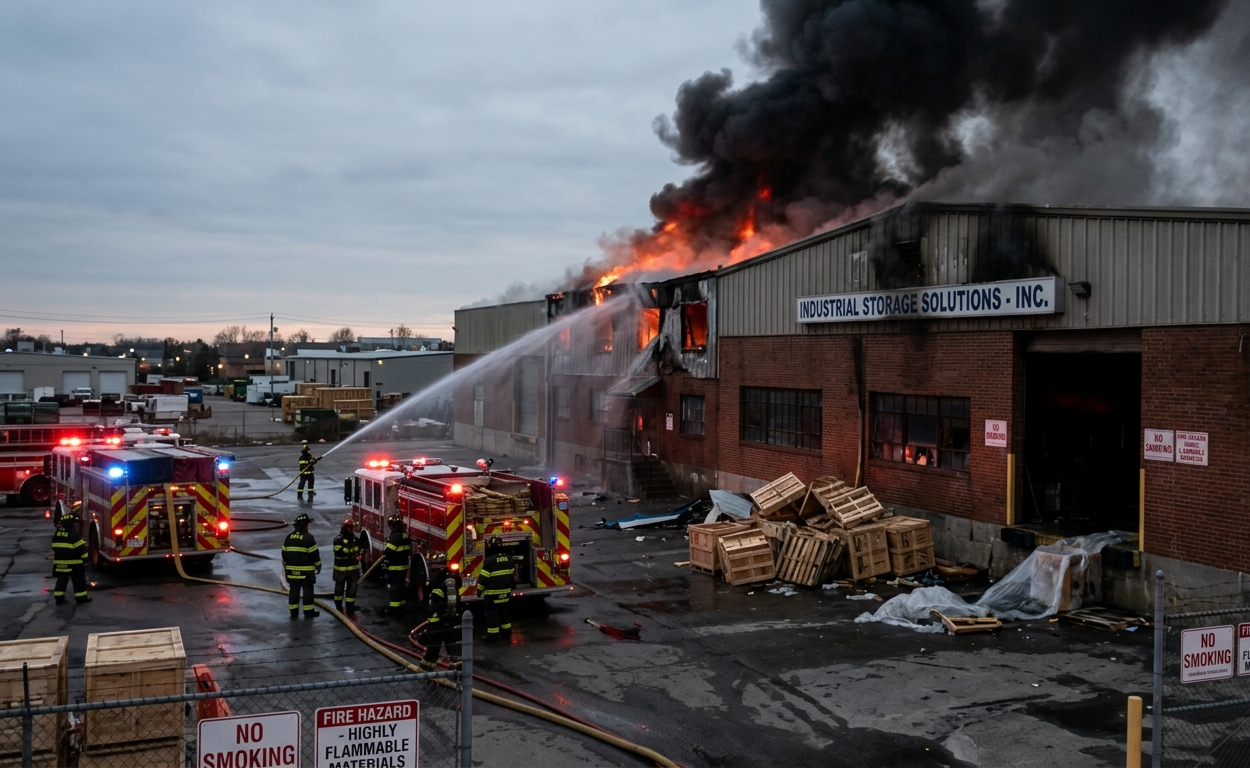
A standard office building has a fire risk profile that most contractors understand. Warehouses are different. The combination of high storage, wide open spaces, forklift operations, and the sheer volume of combustible material creates fire dynamics that ordinary commercial fire protection systems cannot handle.
Three factors make warehouse fires different from other commercial fires. First, the fire load is enormous. A single rack of cardboard boxes contains more combustible material than an entire office floor. When a warehouse fire starts, it grows faster and burns hotter than fires in other building types. Second, warehouse ceilings are high, which changes how heat and smoke behave. Standard commercial sprinklers designed for 10-foot ceilings do not work in a 30-foot warehouse. Third, warehouse operations create constant ignition sources: forklifts, battery chargers, hot work, welding equipment, HVAC systems, and electrical panels running large loads all present risks that office buildings simply do not have.
Because of these factors, warehouses require specific fire protection systems, specific inspection schedules, and specific employee training. A warehouse manager who applies office-building fire safety practices to a distribution center is going to fail their next fire marshal inspection and put their operation at serious risk. This checklist is built specifically for warehouse operations.
Storage and Layout Checklist
How you store material inside your warehouse is one of the biggest factors in fire risk. High-piled storage requires specific spacing, aisle widths, and clearance from sprinkler heads. Get this wrong and you both create a fire risk and violate your permit.
- Verify your high-piled storage permit is current. Storage over 12 feet high in most warehouses (or 6 feet for certain materials) requires a high-piled storage permit from your local fire authority. If your warehouse has this permit, confirm it is up to date and posted.
- Check aisle widths against your permit. Main aisles typically need to be at least 8 feet wide, secondary aisles at least 44 inches. Fire authorities measure these during inspections. Blocked aisles are the single most common warehouse fire code violation we see.
- Maintain 18 inches minimum clearance below sprinkler heads. NFPA 13 requires at least 18 inches of clear space between the top of stored material and the sprinkler head. Racking, shelving, and stored goods that get too close to sprinklers reduce their effectiveness. This is inspected regularly.
- Confirm storage arrangement matches what your sprinkler system was designed for. If your sprinkler system was designed for Class II commodity storage and you are now storing Class IV plastics, your system may no longer provide adequate protection. This mismatch is a leading cause of catastrophic warehouse fires.
- Keep flammable liquids in approved storage cabinets. Flammable liquids over specific quantities (typically 10 gallons) require UL-listed flammable storage cabinets. Reference NFPA 30 for exact quantities based on liquid class and warehouse construction.
- Segregate incompatible materials. Oxidizers, flammables, corrosives, and reactive materials must be stored separately. Your fire authority may require specific separation distances or physical barriers depending on quantities.
- Post storage plan diagrams at each rack aisle. Fire marshals expect to see storage plans that show what commodity classes are stored where. This helps fire responders know what they are facing during an emergency.
Fire Sprinkler System Checklist
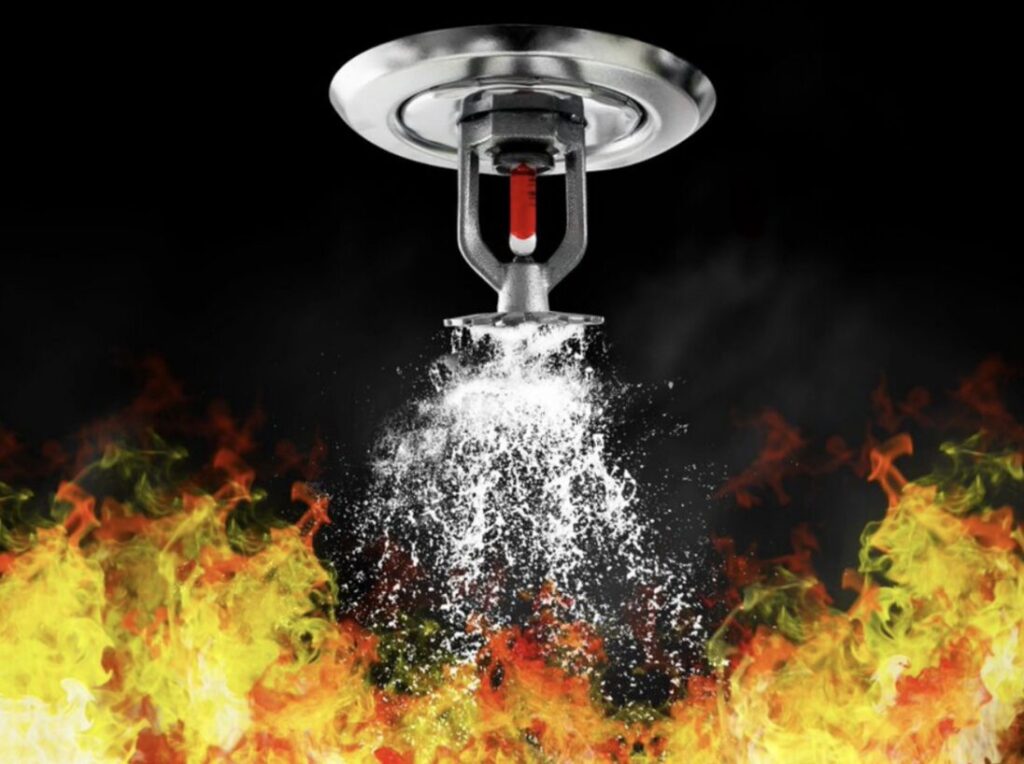
Warehouse sprinkler systems are usually the most complex fire protection systems in any commercial building. Most warehouses require specialized systems like ESFR (Early Suppression Fast Response), in-rack sprinklers, or high-hazard density designs. These systems have specific inspection and testing requirements that go beyond standard commercial sprinkler service. All of it is covered under NFPA 25.
- Weekly visual inspection performed. Someone on your team should visually inspect gauge pressures, valve positions, and any obvious system issues weekly. Document these inspections in a log.
- Monthly inspection completed and documented. A more detailed monthly inspection includes checking control valves, dry pipe valve rooms, and alarm devices. This is typically performed by trained facility staff, not contractors.
- Quarterly professional inspection scheduled. A licensed C-16 contractor should inspect alarm valves, main drain tests, and control valve conditions quarterly. NFPA 25 requires this and fire marshals check for it.
- Annual full system inspection completed within past 12 months. The annual inspection is comprehensive and includes flow tests, alarm testing, and detailed component checks. Documentation must be current and available on site.
- Five-year internal certification current. California Title 19 and NFPA 25 require a five-year internal pipe inspection, obstruction investigation, and often sprinkler head sample testing. Missing this certification is a serious code violation.
- Fire pump tested per NFPA 25 schedule. If your warehouse has a fire pump, it requires weekly no-flow tests and annual full flow tests. Missing or failed fire pump tests are among the most serious findings during warehouse inspections.
- ESFR sprinklers verified for current storage type. ESFR systems only work when storage type matches the design. If you have changed what you store, the system may need modification.
- In-rack sprinklers (if present) inspected and clear. In-rack sprinklers must be visible, clear of obstruction, and free of damage from forklift operations. Damaged in-rack sprinklers are common and often unnoticed.
Because warehouse sprinkler systems are so specific, they should only be serviced by a contractor holding a CSLB C-16 Fire Protection Contractor license. Spectrum Fire Protection holds C-16 #886810 and has serviced warehouse sprinkler systems across Orange County since 1987, including large distribution centers, cold storage, and manufacturing facilities.
Fire Alarm and Detection System Checklist
Warehouses need faster detection than most buildings because fires grow so quickly once they start. Standard smoke detectors often fail in warehouse environments due to dust, temperature swings, and high ceilings. Your fire alarm system needs to be designed for warehouse conditions and maintained accordingly.
- Fire alarm control panel inspected annually. A licensed contractor should test and inspect your fire alarm control panel, initiating devices, and notification appliances annually. Documentation must be available on site.
- Smoke detectors appropriate for warehouse environment. Standard photoelectric or ionization smoke detectors often produce false alarms in warehouses. Beam-type detectors, aspirating smoke detectors, or heat detectors may be more appropriate for high-ceiling warehouse spaces.
- Detection devices tested per NFPA 72 schedule. NFPA 72 requires specific testing frequencies for different device types. Your annual inspection report should list every device tested and its status.
- Notification appliances audible and visible throughout facility. Fire alarms must be audible over background noise (forklift beeps, machinery, HVAC) and visible in every occupied area. Warehouses often need supplemental strobes and horns in loading dock areas.
- Pull stations at every exit and clearly marked. Manual pull stations should be at every exit and at intervals not exceeding 200 feet of travel. Verify they are visible and not blocked by storage.
- Alarm monitoring service active and current. Your fire alarm should be monitored by a UL-listed central station. Confirm your monitoring contract is current and the monitoring company has correct contact information for your facility.
- System tested with fire authority notification annually. During annual testing, coordinate with your monitoring service and local fire authority to test the full alarm-to-dispatch chain. This is often overlooked but critical.
Fire Extinguisher Checklist
Warehouse fire extinguishers are your first line of defense for small fires that could otherwise grow. Because warehouses have varied fire risks (paper and cardboard, electrical, forklift batteries, flammable liquids), you need multiple types of extinguishers strategically placed throughout the facility.
- ABC extinguishers placed no more than 75 feet from any point. NFPA 10 requires ABC extinguishers to be accessible within a 75-foot travel distance from anywhere in the warehouse. Measure walking distances, not straight-line distances.
- Class D extinguishers present if you handle combustible metals. Warehouses handling magnesium, titanium, sodium, or other combustible metals need Class D extinguishers. Standard ABC will make these fires worse.
- Class K extinguishers in any warehouse break room with cooking equipment. Even small break room kitchens with cooking oil require K-class extinguishers. This is inspected.
- CO2 extinguishers near electrical panels and server rooms. CO2 leaves no residue and is safer for electrical fires than dry chemical. Warehouse electrical rooms should have CO2 units.
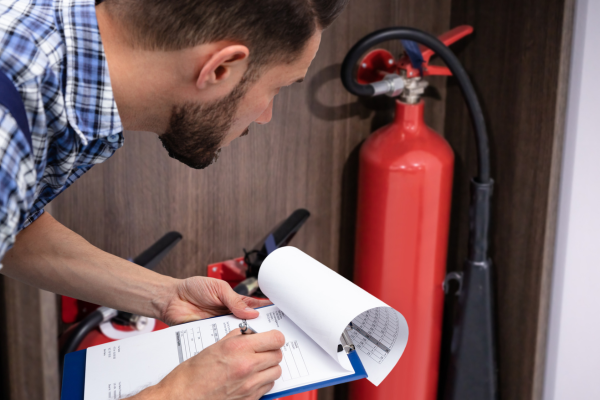
- Every extinguisher has current annual inspection tag. Tags must show the date of the last professional inspection, technician signature, and next service due date. Missing or expired tags are the most common warehouse fire code violation.
- Monthly visual inspections documented. Your staff should visually check every extinguisher monthly, verifying pressure, tampering, mounting, and accessibility. Document these checks in a log.
- Extinguishers mounted at proper height. Extinguishers over 40 pounds must be mounted so the top is no more than 3.5 feet from the floor. Lighter extinguishers can be mounted with the top up to 5 feet from the floor.
- Mounting locations clearly marked with signage. Every extinguisher location must have visible signage that identifies it, especially in warehouses where extinguishers might otherwise be hidden by racks or equipment.
- Hydrostatic testing current per extinguisher type. ABC extinguishers require testing every 12 years. CO2 and K-class need testing every 5 years. Overdue testing means the extinguisher is out of compliance.
Electrical and Equipment Safety Checklist
Electrical failures cause a significant portion of warehouse fires. Combined with the high energy loads warehouses run (forklift chargers, conveyors, HVAC, lighting), electrical hazards need constant attention. This section overlaps with general workplace safety but has warehouse-specific items every facility manager should verify.
- Electrical panels have 3 feet of clear working space. OSHA and NEC require 3 feet of clear space in front of every electrical panel. Storage, equipment, or materials in this space are violations and create serious safety hazards.
- No extension cords in permanent use. Extension cords are for temporary use only. Any cord that has been in use more than a few days is essentially permanent wiring and must be replaced with proper installed circuits.
- Forklift battery charging areas ventilated and separated. Battery charging produces hydrogen gas, which is explosive. Charging areas need ventilation, no ignition sources within specified distances, and emergency eye wash stations.
- Forklift battery charging areas have Class D or specific extinguishers. Lithium-ion forklift batteries require specialized extinguishing agents. Standard ABC extinguishers cannot handle these fires effectively.
- HVAC fire dampers inspected annually. Fire dampers in HVAC ducts prevent fire spread between building compartments. NFPA 80 and NFPA 105 require annual inspection and function testing of these dampers.
- Warehouse HVAC ducts cleaned per NFPA 96 (if kitchen present). If your warehouse has commercial cooking operations, duct cleaning frequency depends on cooking volume. Break rooms typically need annual cleaning.
- Hot work permit system in place. Any welding, cutting, grinding, or other spark-producing work must be performed under a hot work permit. This includes a fire watch, extinguisher on standby, and post-work inspection.
- Emergency shutoffs clearly marked. Master electrical shutoffs, gas shutoffs, and HVAC shutoffs must be labeled and accessible. Emergency responders need to be able to shut down building systems quickly.
Employee Training and Emergency Response Checklist
Even the best fire protection equipment cannot save your warehouse if your team does not know what to do in an emergency. Warehouse employees face specific fire scenarios (rack fires, forklift fires, chemical spills) that require targeted training. We covered the specific fire response procedure in our RACE Fire Safety Guide.
- Written fire prevention plan exists and is available to employees. Cal/OSHA Title 8 Section 3221 requires a written fire prevention plan for employers with more than 10 employees. Your plan must identify major fire hazards, control procedures, and responsible personnel.
- Written emergency action plan exists and is communicated. Cal/OSHA Section 3220 requires a written emergency action plan covering evacuation procedures, employee accountability, and reporting procedures for fires and emergencies.
- RACE procedure taught to all employees. Every warehouse employee should know RACE: Rescue, Alarm, Contain, Extinguish or Evacuate. This training is required by Cal/OSHA and should be documented.
- PASS technique training for fire extinguisher use. Employees expected to use fire extinguishers need annual training on the PASS technique (Pull, Aim, Squeeze, Sweep). Training must be documented with attendee names and dates.
- Fire drills conducted at least annually. While not required by every jurisdiction, annual fire drills are considered best practice and often required by insurance carriers. Document each drill including participation, evacuation times, and any issues identified.
- Designated warden or fire brigade if applicable. Warehouses with 50+ employees or specialized operations often designate warden teams or fire brigades. Members require additional training and equipment.
- New employee training within first week. New warehouse employees must receive fire safety training during their first week, including location of extinguishers, alarms, exits, and assembly points.
- Training records maintained and accessible. Cal/OSHA inspectors expect to see training records showing who was trained, when, on what content. Missing records result in citations even when training actually occurred.
Housekeeping and Ignition Source Checklist
Housekeeping is not glamorous but it prevents more warehouse fires than any single fire protection system. Combustible clutter, spilled flammables, and general disorder create ignition sources and fuel that turn small incidents into total losses.
- Aisles kept clear of debris, pallets, and stored material. Aisles blocked by even temporary storage are code violations and increase fire risk. This is the number one thing fire marshals check during walkthroughs.
- Trash and cardboard removed daily from production areas. Accumulated cardboard, paper, and packaging materials are the single largest fire fuel source in most warehouses. Establish daily removal to designated dumpster or baler areas.
- Combustible waste stored in metal containers with lids. Any combustible waste including oily rags must be stored in metal containers with self-closing lids. Cloth rags contaminated with oils can spontaneously combust.
- Loading dock and receiving areas cleared regularly. Loading docks accumulate pallets, packaging materials, and forklift-damaged goods. Clear these areas daily to prevent buildup.
- Battery charging spills addressed immediately. Battery acid spills need immediate neutralization and cleanup. Standing acid spills can react with warehouse floor materials and other chemicals.
- Smoking prohibited except in designated exterior areas. Warehouse smoking policies must be posted, enforced, and designated smoking areas must be well away from buildings, receiving areas, and combustible storage.
- Vegetation cleared from building exterior. Combustible vegetation, weeds, and brush within 30 feet of the warehouse creates wildfire exposure. This is especially important during California Santa Ana wind season.
- Dumpsters positioned away from building walls. Trash fires spread to buildings when dumpsters are too close. Position dumpsters at least 5 feet from building walls, or use fire-rated dumpster enclosures.
Documentation and Records Checklist
Fire authorities, insurance carriers, and attorneys all judge your fire safety program by your documentation. If it is not written down, it did not happen. Warehouse operations need substantial ongoing documentation to demonstrate compliance.
- Current fire authority permits and certificates on site. High-piled storage permits, occupancy certificates, and any special-use permits must be current and available for inspector review.
- Sprinkler inspection reports from past 5 years available. Weekly, monthly, quarterly, and annual sprinkler reports plus the last five-year certification report should be filed and accessible.
- Fire alarm inspection reports from past year available. Your annual fire alarm inspection report, plus any interim testing records, must be maintained and available for fire authority review.
- Fire extinguisher service records current. Records of annual professional inspections, monthly visual inspection logs, and any recharge or repair work must be documented and accessible.
- Employee training records current. Training records for RACE, PASS, emergency evacuation, and any specialized training must be documented with attendee names, dates, and content.
- Hot work permits from past 90 days retained. Even completed hot work permits should be retained for at least 90 days after the work as evidence of compliant procedures.
- Deficiency corrections documented. When previous inspections identified deficiencies, retain documentation of the corrective actions taken including invoices, service reports, and photos where applicable.
- Insurance loss control reports on file. Your commercial property insurance carrier likely conducts periodic loss control reviews. Keep these reports and any corrective actions taken.
Common Warehouse Fire Hazards to Watch For
Beyond the checklist items above, certain patterns come up repeatedly in warehouse fire investigations. If your facility has any of these situations, treat them as immediate priorities.
Forklift-Related Fires
Forklifts cause a significant percentage of warehouse fires through several mechanisms: hydraulic fluid leaks contacting hot exhausts, battery charging fires, propane tank issues, and forklifts striking sprinkler pipes or fire equipment. Regular forklift maintenance, dedicated charging areas, operator training, and clear equipment travel lanes reduce these risks significantly.
Electrical Panel and Wiring Issues
Warehouses run large electrical loads that stress panels, breakers, and wiring. Signs of trouble include warm outlets, frequent breaker trips, discolored panels, and burning smells. These are precursors to electrical fires and require immediate professional evaluation.
Cardboard and Packaging Accumulation
Distribution centers and e-commerce warehouses generate enormous volumes of cardboard, plastic film, and packaging materials. Even brief accumulation in production areas creates massive fire loads. Daily removal and baled storage in designated areas is essential.
Combustible Dust in Manufacturing Warehouses
Warehouses that handle woodworking, food processing, grain, plastic pellets, or metal powders can accumulate combustible dust. This dust can explode when ignited. Regular cleaning, dust collection systems, and vacuum systems are required for these operations.
Lithium-Ion Battery Storage
Warehouses that store or handle lithium-ion batteries (including e-bikes, scooters, and electronic devices) face growing fire risks. These batteries can experience thermal runaway with almost no warning. Storage requirements, spacing, and specialized suppression systems apply.
Idle Forklifts and Vehicles Parked Overnight
Forklifts, delivery vehicles, and other equipment parked overnight can be sources of ignition through electrical faults or hot components. Park equipment in designated areas away from combustible storage, and where possible, in separate rooms with appropriate fire protection.
What Fire Marshals Actually Check During Warehouse Inspections
Warehouse fire inspections vary by fire authority, but certain items get attention every time. In Orange County, both OCFA and independent city fire departments follow similar priorities. Knowing what inspectors focus on helps you prepare and pass on the first attempt.
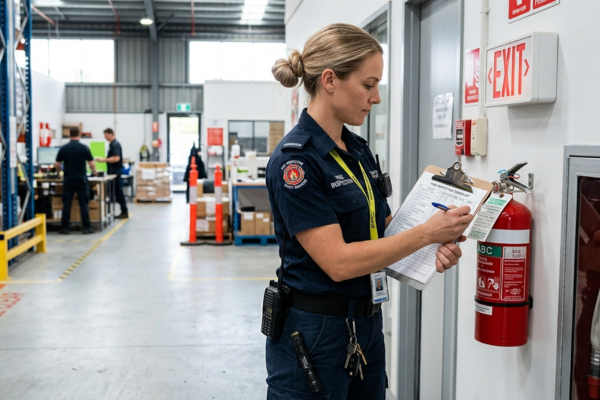
The first thing inspectors check is exit egress. They walk every exit route and verify it is unobstructed, exit signs are lit, exit doors unlock from inside, and the paths lead to safe areas outside. Blocked exits are the fastest way to fail a warehouse inspection.
Second, they verify fire suppression systems are current. This means checking sprinkler valve tags, sprinkler inspection reports, fire pump run test records, and any deficiency correction documentation. Missing or expired tags result in immediate citations.
Third, they inspect fire extinguishers throughout the building. They look at tags, mounting height, signage, accessibility, and appropriate types for the hazards present. K-class extinguishers in kitchen areas, ABC extinguishers throughout the warehouse, and specialty extinguishers near specific hazards are all checked.
Fourth, they examine storage arrangements against your high-piled storage permit. They measure aisle widths, check sprinkler clearances, verify commodity classes match what your permit allows, and look for any storage that has changed since the permit was issued.
Fifth, they check housekeeping and hazard awareness. This includes electrical panel clearances, combustible material accumulation, hot work procedures, and general cleanliness. Fire marshals often note issues here that are technically violations even when they do not result in formal citations.
How to Pass Your Next Warehouse Fire Inspection
Passing a warehouse fire inspection is entirely within your control if you prepare properly. Here is the sequence we recommend to our clients before any scheduled or expected inspection.
Schedule a Pre-Inspection Walkthrough
Two to four weeks before your scheduled inspection, walk your entire facility with the checklist items in this article. Note anything that would fail if the inspector walked through today. This gives you time to correct issues before the actual inspection.
Order Any Pending Service Work
If your sprinkler certification is coming due, your extinguisher tags are expiring, or your fire alarm annual is overdue, schedule that work now. Do not wait until the inspection catches the deficiency.
Assemble Your Documentation Package
Create a binder or digital folder with all current inspection reports, permits, training records, and correction documentation. Have it ready for the inspector when they arrive. Being organized signals that you take fire safety seriously.
Brief Your Team
Let your warehouse staff know an inspection is coming. Review key safety procedures, ensure everyone knows where extinguishers and exits are, and remind them that clean aisles and clear exit paths matter.
Address Any Known Deficiencies
If you know something is out of compliance (an overdue certification, a damaged sprinkler head, an expired extinguisher tag), correct it before the inspection. If time does not allow full correction, at least schedule the corrective work and have documentation showing that work is scheduled. Inspectors extend correction periods for facilities that show active progress on known issues.
When to Call a Professional Fire Protection Contractor
This checklist covers what a facility manager can do internally. But certain fire safety work legally requires a licensed contractor. Attempting these tasks with unqualified personnel creates code violations, safety risks, and legal liability.
Fire sprinkler installation, modification, and inspection requires a CSLB C-16 Fire Protection Contractor license. Fire alarm electrical work requires a C-10 Electrical Contractor license. Fire extinguisher certification requires a State Fire Marshal E-2293 license. Kitchen suppression work requires a State Fire Marshal A-0448 license. Using unlicensed contractors produces work that fire authorities will not accept.
Spectrum Fire Protection holds all of these licenses and has been serving Orange County warehouse operations since 1987. Sam K., our founder, has personally led fire protection work at distribution centers, cold storage facilities, e-commerce fulfillment centers, and manufacturing warehouses across Orange County for 39 years. Our team understands the specific fire protection requirements that apply to warehouse operations and provides service that passes inspection the first time.
If your warehouse needs a comprehensive fire safety review, we offer free consultations for California facility managers. Contact Spectrum Fire Protection to schedule a walkthrough. Our team will assess your current fire protection status, identify any gaps against this checklist, and provide a written report with recommended actions. Call (714) 213-8451 or schedule a consultation online.
The Bottom Line on Warehouse Fire Safety
Warehouse fire safety is not complicated but it requires ongoing attention across many categories. This checklist covers what actually matters: storage arrangements, sprinkler systems, fire alarms, extinguishers, electrical safety, employee training, housekeeping, and documentation. Every item on this list is a place where warehouse fires start when the item is ignored.
The facilities that avoid warehouse fires share a common pattern. They maintain relationships with qualified fire protection contractors. They train their teams. They document everything. They walk the facility monthly to catch issues before inspectors do. And they treat fire safety as an ongoing program rather than an annual event.
If your Orange County warehouse could benefit from a comprehensive fire safety review by a team that has been doing this work since 1987, contact Spectrum Fire Protection for a free consultation. We will walk your facility, review your existing fire protection status against this checklist, and provide a written report with prioritized recommendations. Call (714) 213-8451 to schedule.


.png)

.png)

.png)


.png)