

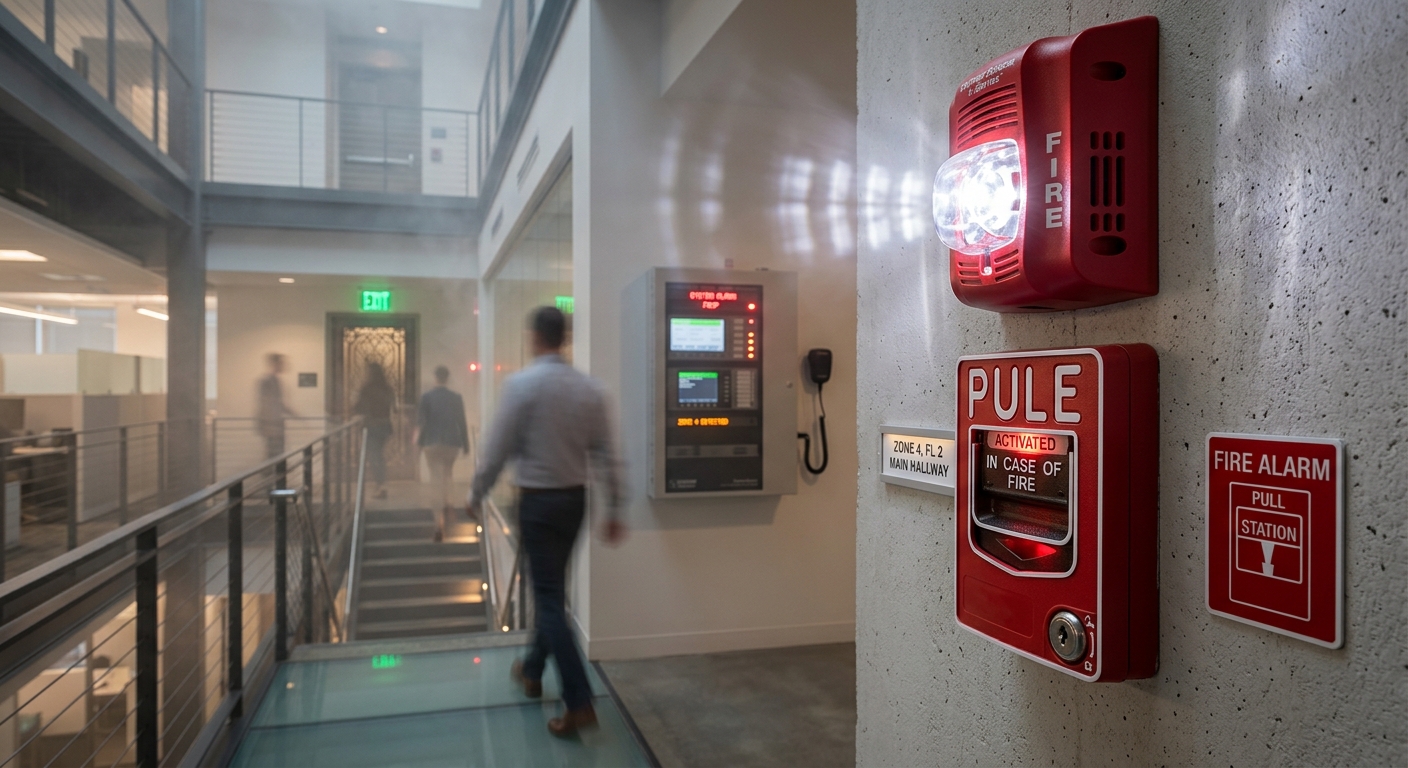
Quick answer: Nationally, commercial fire alarm monitoring, the recurring monthly service, not the cost of installing the system itself, typically runs $25 to $110 a month, with most buildings landing somewhere between $50 and $100. In Orange County, pricing commonly falls in the $75 to $95 per month range, depending on how many zones your system has, which communication path it uses, and what kind of reporting your insurance carrier or fire authority requires. That's the ongoing monitoring fee only. Installing or upgrading the fire alarm system itself is a separate, much larger one-time cost.
That distinction between monitoring and installation trips up more property owners than any other part of this question. Here's the full breakdown.
Monitoring Cost vs. Installation Cost: Two Different Numbers
A lot of pricing guides online quote a single, wide number, sometimes $5,000, sometimes $50,000, without being clear about what's actually included. Almost always, that big number is the cost of installing the fire alarm system itself: the control panel, smoke and heat detectors, pull stations, notification devices, and wiring. Depending on building size and system complexity, that one-time installation cost commonly runs anywhere from $1,500 for a small tenant space to well over $100,000 for a large, multi-tenant, addressable system.
Fire alarm monitoring is a separate line item: the recurring monthly service that connects your already-installed panel to a 24/7 central station. If you already have a working fire alarm system and you're specifically asking what monitoring costs, the installation number isn't relevant to your question, and a quote that conflates the two isn't answering what you actually asked.
What Actually Drives Your Monthly Monitoring Price
Monitoring pricing isn't arbitrary. A handful of specific factors determine where a building lands within the typical range:
Number of zones. More zones means more distinct signal paths the central station has to track, identify, and report on individually. A single-zone retail suite costs less to monitor than a 40-zone office building.
Communication path. Cellular, IP, or dual-path monitoring each carry different equipment and connectivity costs, which typically shows up in the monthly rate. Dual-path, running two independent paths simultaneously for redundancy, generally costs more than a single path, for the same reason it's more reliable.
Reporting requirements. Some insurance carriers or corporate portfolios require custom reporting, multi-property rollups, or specific documentation formats beyond a standard monthly test report. That level of service costs more than a basic account.
Property type. A restaurant with kitchen suppression signals integrated into the same monitoring account, or a hotel needing room-by-room notification tracking, involves more complexity than a straightforward office suite, even at a similar square footage.
Typical Price Ranges by Building Type
General ranges, based on current market data across providers, not just one company's pricing:
These are general ranges, not a quote. The only way to get an exact number for a specific property is a site walk, since zone count and communication path aren't things you can estimate accurately from square footage alone.
Does the Communication Method Change the Price?
Usually, yes, modestly. Cellular monitoring has become the standard for most commercial buildings as landline phone service is phased out, and pricing for it typically sits in the middle of the range. IP-based monitoring, using a building's existing internet connection, can come in slightly lower since it doesn't require dedicated cellular hardware, though it depends on having reliable internet service to begin with. Dual-path monitoring, cellular plus IP running simultaneously, usually costs somewhat more than either single path, which is the trade-off for the redundancy: if one path fails, the connection doesn't go down with it.
For buildings still running an older phone-line-based communicator, the more urgent cost question usually isn't the small monthly difference between paths. It's the one-time cost of upgrading the communicator itself before landline service in the area is discontinued. Some monitoring providers include this upgrade at no upfront cost on annual plans, which is worth asking about directly rather than assuming it's a separate charge.
Hidden Fees to Watch For
The advertised monthly rate isn't always the full picture. A few line items worth asking about before signing:
Per-dispatch charges. Some providers bill separately every time an alarm actually activates and gets dispatched to the fire department, on top of the base monthly fee. A legitimate alarm event shouldn't come with a surprise invoice.
Activation and equipment fees. A one-time setup charge is normal. A recurring "equipment rental" fee on top of the monthly rate, for equipment you don't own at the end of the contract, is worth reading closely.
UL certificate fees. Some providers charge a separate annual fee to issue the UL certificate your insurance carrier may require for a premium discount. Ask whether it's included or billed separately.
Auto-renewal and evergreen contract clauses. This is one of the most common complaint categories with California's alarm company regulator, a contract that silently renews for another multi-year term unless canceled within a narrow window. Read the term length and renewal language before signing, not after you're trying to switch providers.
Spectrum Fire Protection runs on flat monthly pricing that includes monitoring, testing, unlimited dispatches, and documentation, with no per-dispatch charges and no five-year auto-renewal contract, specifically because these are the line items that turn an advertised low rate into a higher real one.
What a Fair Monthly Rate Should Actually Include
Before comparing two quotes on price alone, confirm both are actually covering the same scope:
- 24/7 monitoring through a UL 827 listed central station, not a shared queue with burglar and medical alarms
- Monthly test signal confirmation, so you know the connection is actually working before an inspector asks
- Documentation and reporting for your fire authority and insurance carrier, included rather than billed as an add-on
- A clear, published dispatch time standard, not just "we monitor 24/7" without a number attached to it
- No cost to switch providers if a contract term ends, beyond the normal handoff process
The Real Cost of Going Cheap, or Going Without
Monitoring cost doesn't exist in a vacuum. A few numbers worth weighing against the monthly rate:
Insurance premium impact. Properly certified, UL-listed monitoring is commonly cited as qualifying commercial properties for insurance premium reductions in the range of 15 to 25 percent. On a mid-size commercial policy, that easily outweighs a monitoring bill within the first year.
Fire watch cost if monitoring lapses. If a required fire alarm system goes out of service without monitoring in place to catch it quickly, California's fire watch requirements can mean paying trained personnel to patrol a building continuously, a cost that commonly exceeds an entire year of monitoring fees within just a few days.
False alarm fines. Repeat false alarms carry escalating fines in most jurisdictions, sometimes reaching several hundred dollars per incident for repeat offenders. Reliable monitoring with proper signal verification reduces how often this becomes a real cost.
None of this means the cheapest quote is automatically the wrong choice. It means the monthly number by itself is an incomplete way to compare two providers.
How to Get an Accurate Quote for Your Building
Because zone count, communication path, and property type all affect the price, a number pulled from a website table is always going to be a range, not your actual quote. The reliable way to get a real figure:
- Have your current fire alarm panel's zone count and communication type on hand, or let a technician confirm it during a site visit
- Ask whether the quote includes testing, documentation, and unlimited dispatches, or whether those are billed separately
- Ask directly about contract length and renewal terms before comparing the monthly number
- A free site consultation is normally enough to walk your specific property and return an exact number rather than a range.
Frequently Asked Questions
What's the average cost of fire alarm monitoring for a small business?
For a small, single-zone commercial tenant space, monthly monitoring typically runs $50 to $75. The exact number depends on the communication path used and whether any additional reporting is required by an insurance carrier or landlord.
Is fire alarm monitoring cheaper with a long-term contract?
Sometimes providers offer a modestly lower rate for a longer commitment, but a lower monthly number tied to a multi-year auto-renewing contract can cost more over time than a slightly higher flat rate with no lock-in, especially if switching providers later triggers early termination fees. It's worth comparing total cost over the likely length you'll actually use the service, not just the advertised monthly figure.
Does fire alarm monitoring cost include annual inspections?
It depends on the provider. Some monitoring plans bundle monthly test signals and annual system testing into the flat rate; others bill inspections separately. This is one of the first things worth confirming when comparing quotes, since it can make an apparently cheaper monthly rate more expensive once inspection costs are added back in.
Why do fire alarm monitoring quotes vary so much between companies?
Beyond the base rate, the real variation usually comes from what's included: unlimited dispatches versus per-dispatch billing, included documentation versus a separate reporting fee, and contract length and renewal terms. Two quotes with the same headline number can end up costing very different amounts once the full scope is compared. A detailed, written quote after a site visit is the only reliable way to compare two providers accurately.
The Bottom Line
Commercial fire alarm monitoring typically costs $25 to $110 a month nationally, with most Orange County buildings landing around $75 to $95, driven mainly by zone count, communication path, and reporting requirements, not building size alone. That number is separate from the cost of installing the system itself, and the real comparison between providers has to account for what's actually included, not just the monthly figure on a website.
Spectrum Fire Protection has provided flat-rate commercial fire alarm monitoring for Orange County properties since 1987, with no per-dispatch fees and no five-year auto-renewal contracts. Visit our fire alarm monitoring page for current pricing, or request a free site consultation for an exact quote on your building.


.png)


.png)

.png)


.png)