

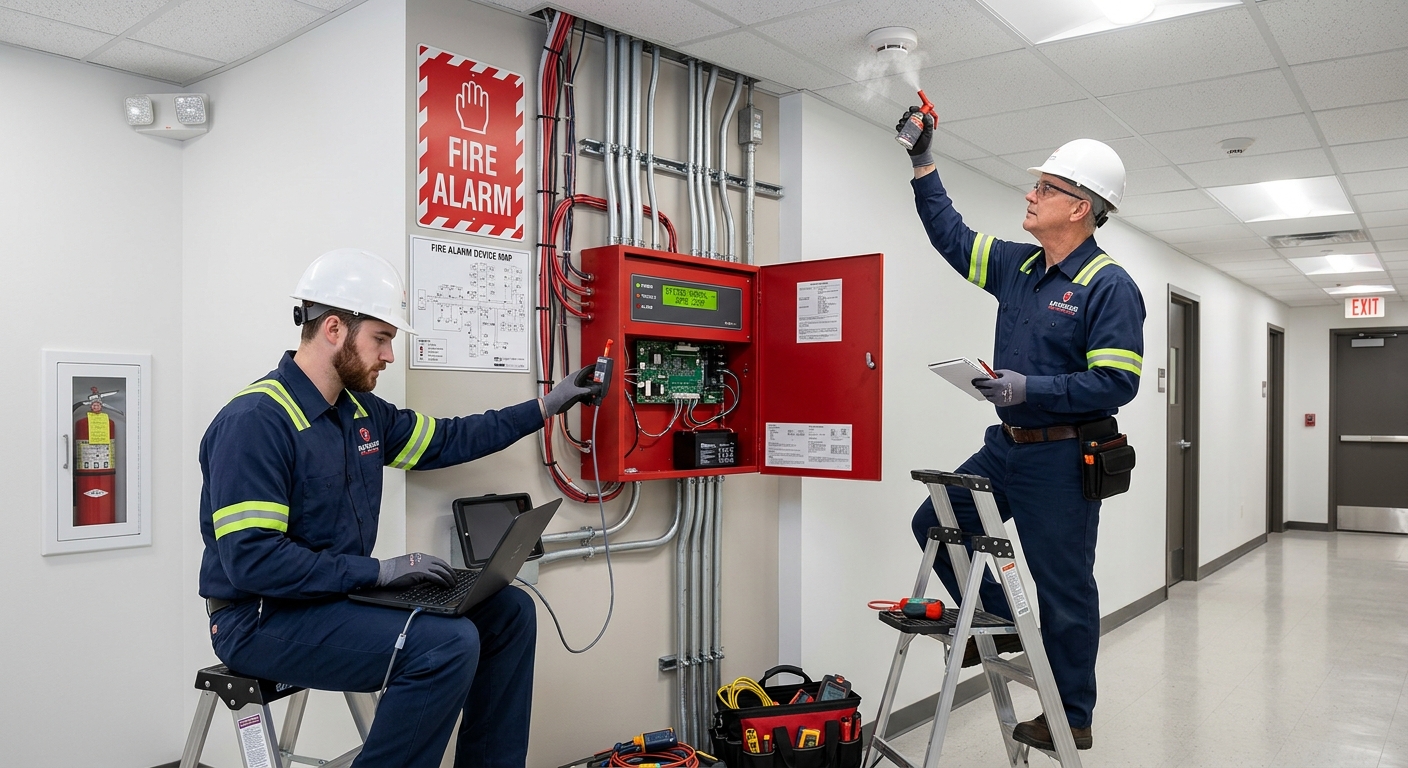
Quick answer: NFPA 72 requires a commercial fire alarm signal to reach a listed supervising station within 90 seconds of activation, requires that connection to be continuously supervised so a dropped line gets caught fast, and requires at least 24 hours of battery backup so the system keeps working through a power outage. The station receiving that signal has to hold UL 827 certification. In California, your local fire authority then layers its own requirements on top of all of it.
What NFPA 72 Actually Covers, in Plain Terms
NFPA 72, the National Fire Alarm and Signaling Code, is the document that tells a fire alarm system what it's legally required to do: how it detects a fire, how it notifies the people inside a building, and, the part most property owners know least about, how it gets word out to the fire department. That last piece is fire alarm monitoring, and it's governed almost entirely by one chapter: Chapter 26, Supervising Station Alarm Systems.
Most people who own or manage a commercial building already know they need smoke detectors and pull stations. Fewer know that having those devices isn't the same as being compliant. A fire alarm system that detects smoke but has no reliable way to tell anyone outside the building is, from a code standpoint, incomplete. Fire alarm monitoring is the piece that closes that gap, and it's the piece Chapter 26 spends the most time regulating.
The Core Requirement: Monitoring Through a Listed Supervising Station
Any commercial fire alarm system that requires monitoring has to connect to a supervising station, and that station has to be listed for the job. In practice, that listing is UL 827, the certification that verifies a monitoring center actually has the staffing, backup infrastructure, and signal-handling procedures NFPA 72 assumes it has. A monitoring service that isn't UL listed can call itself monitoring, but it isn't meeting the code, and it's usually the first thing a fire marshal or insurance adjuster checks after an incident.
The Three Types of Supervising Stations
NFPA 72 recognizes three ways a building can be monitored, and the difference matters more than most property owners realize:
Central station. A third-party company, listed and in the monitoring business, watches signals from many buildings at once. This is what almost every commercial property uses, including the monitoring Spectrum Fire Protection provides for commercial buildings across Orange County.
Proprietary supervising station. The building owner runs their own monitoring center, usually a large campus, hospital system, or corporate portfolio with enough properties to justify staffing one internally.
Remote supervising station. A hybrid: a listed station watches the signals, but doesn't handle the installation, inspection, or maintenance the way a full central station relationship does.
For the overwhelming majority of commercial buildings, central station monitoring is the answer, mainly because it's the only option that doesn't require building and staffing a monitoring center yourself.
The 90-Second Rule
This is the number that actually matters day to day: NFPA 72 requires an alarm signal to be received and displayed at the supervising station within 90 seconds of the initiating device activating. Not 90 seconds to notify the fire department, 90 seconds for the signal to arrive at the monitoring center in the first place.
From there, a trained operator confirms what kind of signal came in and retransmits it to the fire department's dispatch center immediately. There's no code-sanctioned delay built in for fire alarm signals the way there sometimes is for burglar alarms. That total window, detection to dispatch, is the number Spectrum Fire Protection guarantees under 90 seconds on every monitored account, because it's the same number the code is built around.
If your current monitoring provider can't tell you what their actual detection-to-dispatch time looks like, that's worth asking about directly.
How the Signal Actually Gets There: Communication Paths
Chapter 26 also governs how the signal travels from your building to the monitoring center, and this is the part of NFPA 72 in the middle of a real, current shift. For decades, the standard method was a phone line, a digital alarm communicator transmitter dialing out over copper. That's changing because the copper itself is disappearing: AT&T, Verizon, and other carriers are actively retiring POTS lines across California, which means a system built around a landline-only communicator can lose its monitoring connection without anyone touching the fire alarm panel.
The code doesn't require a phone line specifically. It requires a communication path that meets certain performance standards, and several technologies now qualify:
Cellular monitoring, using commercial LTE networks, independent of the building's phone or internet service. This is the direction most buildings are moving as POTS is phased out.
IP-based monitoring, using the building's existing internet connection, with the advantage of near-instant transmission and continuous line supervision.
Dual-path monitoring, typically cellular plus IP running simultaneously, so a failure in one path doesn't take down the whole connection. NFPA 72 requires this level of redundancy for high-hazard occupancies, and most insurance carriers prefer it even where it isn't strictly mandatory.
Radio monitoring, a dedicated private radio network, mostly reserved for high-security facilities or buildings in areas with unreliable cellular coverage.
If your building is still running a phone-line-only communicator, it's worth checking now rather than after the line stops working. Spectrum Fire Protection includes the cellular communicator upgrade at no upfront cost on annual monitoring plans, specifically because of how many Orange County buildings are still on the old hardware.
Communication Path Supervision
Having a communication path isn't enough on its own. NFPA 72 also requires that path to supervise itself. A single communication path has to be checked at intervals no longer than 60 minutes, and if it fails, that failure has to be reported within that same window. Buildings running dual-path systems get checked even more frequently, and the code doesn't allow a single point of failure that could take both paths down at once. The entire reason dual-path exists is so one failure doesn't leave a building blind.
This is also why a monitoring provider's own reliability matters as much as the equipment. A supervised path that reports a failure is only useful if someone is actually watching for that report and acting on it.
Backup Power: The 24-Hour Rule
Fires don't wait for good weather, and NFPA 72 assumes the power will go out at some point during a system's life. Section 10.6.7.2.1 requires a fire alarm system to run for at least 24 hours in standby mode on battery backup, followed by at least 5 minutes in full alarm mode, or 15 minutes if the system includes voice or mass notification capability. In practice, this means the batteries in your fire alarm panel aren't sized for "a few hours." They're sized to carry the building for a full day without utility power and still have enough left to run notification if a fire happens right as that day ends.
Undersized or aging batteries are one of the most common deficiencies fire inspectors find, mostly because a battery can look fine on a quick visual check and still fail the actual load test.
Testing and Documentation: Chapter 14
None of the above matters if it isn't tested. NFPA 72's Chapter 14 sets the inspection, testing, and maintenance schedule that keeps a monitored system honest: monthly communicator test signals to confirm the path to the monitoring center is actually working, plus a full annual test of the system against current code. Every test has to be documented, because that documentation is what a fire marshal reviews during an inspection and what an insurance carrier asks for after a claim.
Spectrum Fire Protection handles this as part of ongoing monitoring service, with monthly automated reports and annual comprehensive testing documentation built in rather than billed separately.
California Adds Its Own Layer on Top
NFPA 72 is the baseline, but it isn't the only code a California commercial building has to satisfy. The California Fire Code adopts NFPA 72 and then layers Title 19 amendments on top of it, and local fire authorities across Orange County, OCFA, Fullerton Fire Department, Anaheim Fire & Rescue, and others, each apply their own local requirements on top of that. The core monitoring requirements (90-second transmission, UL 827 listing, backup power) stay consistent everywhere, but permit processes, documentation formats, and inspection scheduling can vary from one city's fire authority to the next.
This is the part that trips up buildings that recently changed cities, changed ownership, or worked with a contractor unfamiliar with the specific jurisdiction. We work directly with fire authorities across Orange County on every monitored building, so the local layer gets handled at the same time as the underlying NFPA 72 requirement, not as an afterthought.
What Happens If a Building Isn't Compliant
Non-compliance with NFPA 72 monitoring requirements usually surfaces one of two ways: a routine fire inspection catches it, or a fire happens and it comes up during the claims process. Neither is a good way to find out. A fire marshal can issue a citation and require immediate correction. An insurance carrier can deny a claim outright if the building wasn't monitored the way its policy assumed. And an unmonitored or improperly monitored system can affect a certificate of occupancy review.
The good news is that fixing this is usually straightforward once someone actually looks at the system. A single site consultation is normally enough to identify whether a building's current setup meets Chapter 26, has the right communication path, and has backup power sized correctly.
A Quick Way to Check Your Own Building
Before calling anyone, here's what's worth checking yourself:
- Does your fire alarm panel connect to monitoring through a phone line, cellular, IP, or a combination? If it's phone-line only, that's worth flagging given the POTS phase-out already underway.
- Do you know who your monitoring provider is, and whether their central station is UL 827 listed? If you're not sure, that's a sign it's time to ask.
- Do you have documentation of your last monthly test signal and annual test? If you can't produce it quickly, it may not be happening on schedule.
- Do you know your system's backup battery age? Batteries typically need replacement every 3 to 5 years, and an aging battery is the single most common cause of a failed backup power test.
- If any of those questions don't have a confident answer, it's worth a conversation before, not after, an inspection or an incident forces the issue.
Frequently Asked Questions
Does every commercial fire alarm need to be monitored?
Most do. If your building's occupancy type or local fire code requires a fire alarm system in the first place, that system almost always has to be monitored by a listed supervising station under NFPA 72. A small number of low-hazard, low-occupancy buildings may be exempt, but that's a determination worth confirming with your local fire authority rather than assuming.
What's the difference between NFPA 72 and UL 827?
NFPA 72 is the code that sets the requirements: signal transmission time, supervision, backup power, testing. UL 827 is the certification that verifies a specific central station actually meets those requirements in practice, staffing levels, backup systems, and signal-handling procedures included. You need both: a system designed to NFPA 72, monitored by a UL 827 listed station.
How often does a monitored fire alarm system need to be tested?
NFPA 72 requires monthly communicator test signals to confirm the connection to the monitoring center is active, plus a full annual test of the system against current code. Some jurisdictions and insurance requirements call for more frequent testing on top of that baseline.
Can I switch monitoring providers without losing coverage?
Yes, and it shouldn't require any downtime if it's done correctly. A proper takeover involves the new provider coordinating with the old one, updating the communicator if needed, connecting to the new central station, and notifying the local fire authority, all without a gap in active monitoring.
Is a phone-line-based fire alarm system still code compliant?
It can be, for now, but it's a shrinking option. NFPA 72 doesn't ban phone lines outright, but major carriers are actively retiring the copper POTS infrastructure those systems depend on, independent of what the fire code requires. A building still running phone-line-only monitoring should plan for a cellular or IP upgrade before the line itself becomes the point of failure, not after.
The Bottom Line
NFPA 72's monitoring requirements exist because a fire alarm that no one hears outside the building doesn't actually protect anyone. The code is specific for a reason: 90 seconds to the supervising station, continuous supervision of the connection, 24 hours of backup power, UL 827 certification for whoever's on the other end. None of it is arbitrary, and none of it is optional for a commercial building that requires a fire alarm system in the first place.
Spectrum Fire Protection offers a free consultation to walk your property, check your panel and communication path against current code, and tell you exactly where you stand. No phone-quote guesswork, no obligation. Reach out through our fire alarm monitoring page to get started.


.png)

.png)

.png)


.png)